Showing posts with label coffee. Show all posts

Thursday, November 21, 2013

Kopi Luwak: the myth, the reality and the tasting.

Kopi Luwak conjures up images of disgust as well as extremely good coffee...often at the same time. Why? Read on.


The ground beans from Liberica coffee, eaten, digested, cleaned, processed, roasted, being brewed using the Siphon method for a clean cup.

I had the opportunity to visit My Liberica coffee, an almost fully and vertically integrated coffee joint, just across the border in Johor.
Owned and operated by a passionate coffee lover, Jason.

Jason is in the process of converting his family palm oil plantation to a superior Liberica coffee plantation. And passionate enough to want to control every step of the process...from growing the beans, to processing (within the next 6 months, as he is currently building a processig facility), roasting, cupping, and final delivery to his own coffee shop. Very interesting.

The road leading into the plantation is only accessable by 4 wheel drive...it was quite a ride to where the coffee plants are.

While most high end coffee is Arabica, Jason chose to grow Liberica because it thrives well in the slightly acidic soil in his farm, and it is a lowland coffee varietal, similar but perhaps a bit more robust than Robusta. Arabica cannot be grown in lowlands, require a high altitude and cooler temperatures.Interestingly, Liberica plants are actually trees, if left without pruning and good husbandry, will grow to some 30m tall, while Arabica when left to its own vices will only reach about 4m or so, and thus typically known as a shrub.

The coffee cherries, ripe for the picking.

A husky shell covers the berry within, which is basically a bean with a thin fleshy layer, with a mildly sweet taste.

Typically two beans are found within each berry. But occassionally, a genetic anomaly causes one of the beans to be vestigal, allowing the berry's goodness to be focussed on the single good bean, resulting in a peaberry:

In the normal plantation process, the ripe berries are hand picked and sent to the processing plant for the husk and fleshy part to be removed, then the beans extracted, dried, washed, and cleaned. But nature has its own way...civet cats, in this case, wild ones pick the best and sweetest berries, and eat them. The cat breaks open the husk and eats the beans with the fleshy bits whole.

As shown above, this is the berry opened and eaten by the cat, and discarded. The beans pass through the cat's digestive system, and the bio process adds dimension and character to the beans, which are passed out of the system.

These are picked up by workers, and sent to the plant for processing. As this is a rather random process, the amount of kopi luwak produced thus is very small, thus making it a very expensive bean. In many other countries, like Indonesia and Vietnam, the civet cats are kept in captvity in cages, and fed the berries. While at My Liberica, the cats are wild, and being omnivorous, eat other small animals, insects, fruits. Providing a more interesting and complex layering of flavours in the animal's digestive track.

The picked beans are washed of defecate matter, and cleaned throughly. The beans are then roasted, to just the start of the second crack, as Jason wants to preserve the character of the beans. And used exclusively at his elegant cafe in a high end part of Johor Bahru.

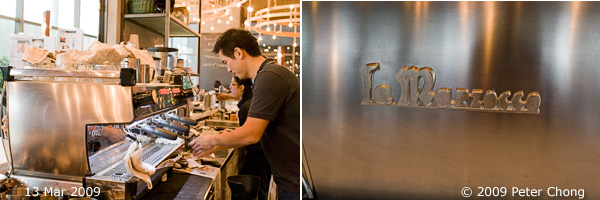
The cafe has divers of coffee apparatus for all the different methods of brewing coffee. From a La Marzocco GS5 taking pride of place serving out espresso styled drinks, to filter coffee and Jason's preferred method to brew the kopi luwak...by siphon.

And the result, a bright, clean coffee, presented in a beautiful, porcelean cup, with gold edgings.

Before serving us the kopi luwak (RM50+tax per cup), Jason dished up the same Liberica beans, but not bio processed rather regular coffee processing, and roasted to rolling second crack...a la French Roast. The coffee was robust, heavy bodied, but rather one dimensional. In comparison, the same beans, but bio processed by the civet cat, and roasted a bit less dark, shows the same body, but with layers of flavours. Much more complex structure, with hints of berries, caramel, chocholate being obvious. A sweetish after taste is also noted. This is the first time I have been impressed with Kopi Luwak, given my adventures with them...Vietnam Weasel coffee which I roasted and pulled as a single origin espresso to the ibrik style kopi luwak I had in Jakarta recently.

Bravo Jason for your passion and dedication. It shows in the products you have selected to present to your customers, and it shows your respect and good taste in coffee. Highly recommended to try this cafe in Taman Molek. Their espresso is also superb, as is the cold drip ice coffee.

Read also, Tony's account of the same visit at Johor Kaki blog.

My Liberica
73 Jalan Molek 3/10, Taman Molek, 81100 Johor Bahru, Johor, Malaysia
+60 10-760 7792
https://www.facebook.com/pages/My-Liberica-Coffee/223872167624130

Thursday, January 14, 2010

Feasting in Penang: Toh Soon Cafe

with family

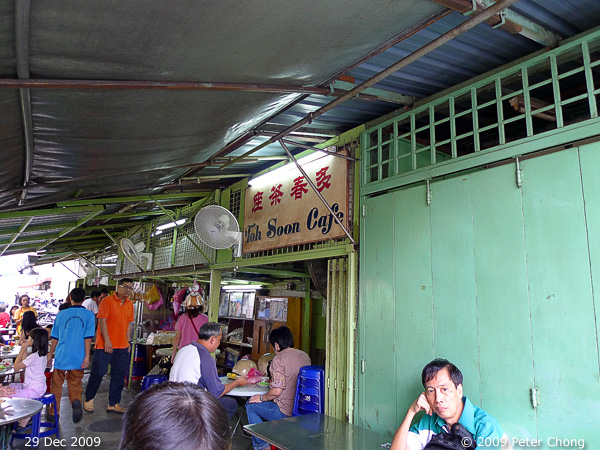
Located in a side street along Lebuh Campbell, this small cafe is almost perpetually full...the actual cafe is no more than a hole in the wall of a corner terrace shop, and a tentage is set up to cover the side road...with tables and stools setup for customers.


This shop has been around for ages. The attraction is the coffee, and the various offers of bread...toasted, steamed, with kaya, with butter...huge list of offerings.

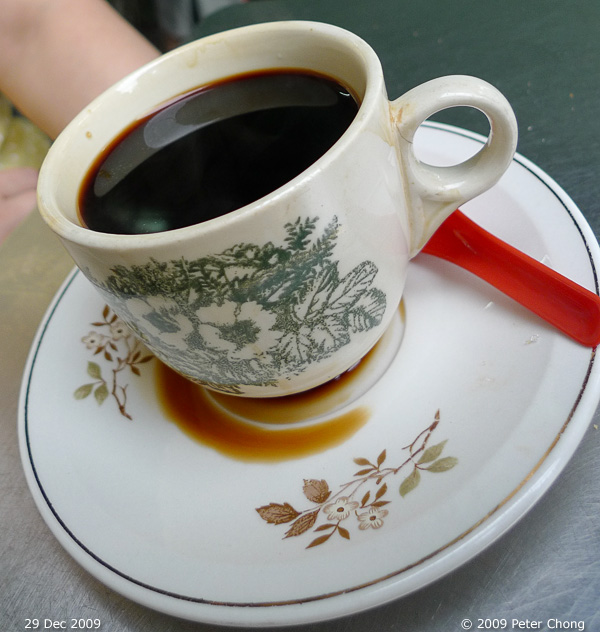
We started the morning breakfast with black coffee...kopi-o.


Black, totally opaque, the coffee is probably brewed from coarsely ground robusta beans. Typical of the kopitiam coffee, this is usually roasted with maize, and often with margerine. The grounds are brewed using the sock method...where the grounds are placed in a muslin bag, and brewed in a pot with hot water. Toh Guan's coffee is thick, flavourful...a robust, full body flavour, and a distinct fragrance. The nose is not like those we get from the more aromatic arabica, but a thick, dense, smokey fragrance which is also very addictive.

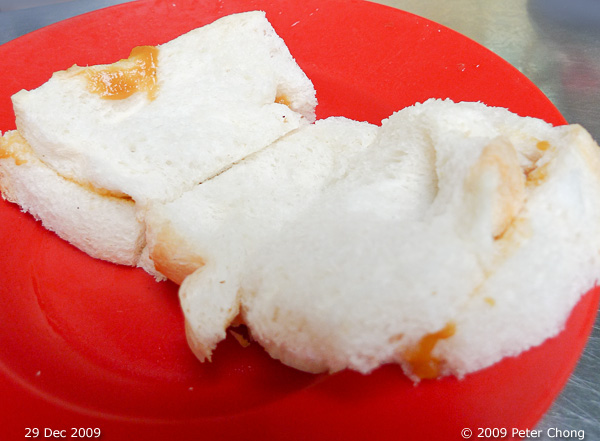
But on to the breads. We start off with steamed local bread:


Two slices of local bread...commonly known as bengali bread...this is different from the factory made bread like those offered by Gardenia, in that I think it contains less gluten, and often free of preservatives. Just flour, yeast, often allowed to rise fully...making the bread very airy, and baked till the outer crust develops into a deep brown. The crust is typically cut off and not served.

Steaming causes the bread to become a bit more elastic than it would have been. It also softens and moistens the bread. Very nice. I wonder why steamed bread is seldom offered.

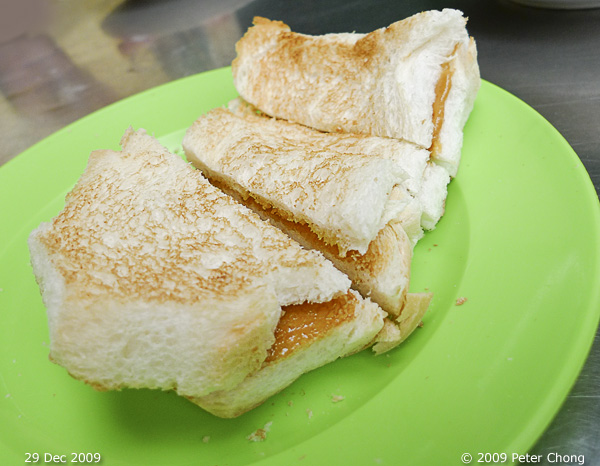
Also lightly toasted butter kaya bread.


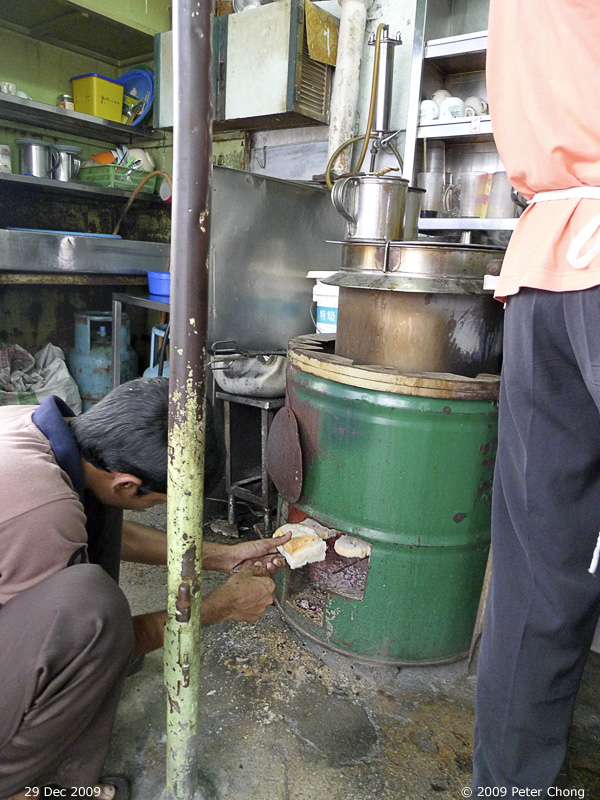
The same bengali bread is lightly buttered and spread with kaya. And toasted in a truly old charcoal oven, shown below:


I am not sure why the oven is situated in the lower part of the stove...toasting bread becomes a back breaking exercise of having to stoop low to insert and remove the bread.

But the bread is excellent. Toasted lightly, it maintains a crisp exterior, while the interior is nice and soft. The butter is fairly generous, but the kaya is a bit lacking. It did not have the fragrance, nor the intensity as that found in Killiney, or my mom's home made stuff. On top of that, the amount of kaya spread was not generous.

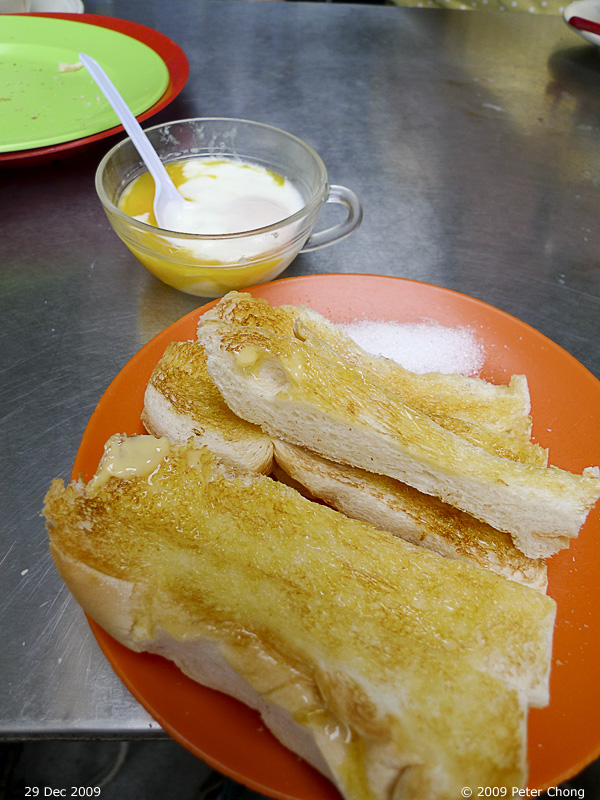
We also ordered just plain buttered toast, to be eaten with half boiled eggs:


This was quite brilliant. Nicely toasted, with melted butter. And torn into small bite sized portions and dunked in the liquid half boiled eggs. Very nice.


Toh Soon Cafe
Lebuh Campbell (Penang Road side)


View Toh Soon Cafe in a larger map

Saturday, May 2, 2009

Weasel Coffee: Second roast

My first try at roasting and brewing espresso from the Weasel Coffee I bought from Vietnam was a mini-disaster. I could not estimate the roast profile, and the coffee over-roasted. The report is here.

My second try was far better.


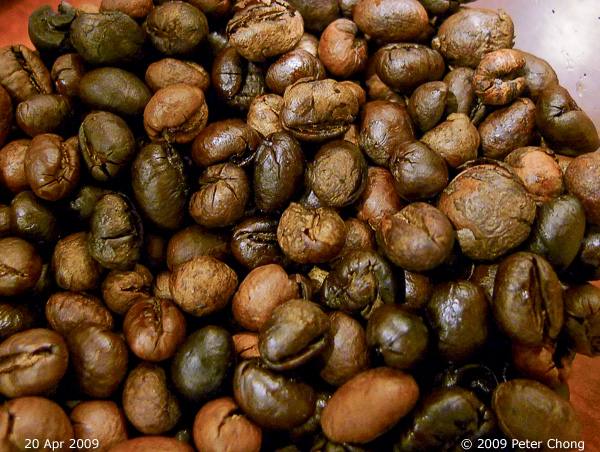
The peaberry beans are rather larger than regular beans. Measuring about 4 to 5mm in length, and rather fat, round diameter.

The extraction, shown here in video is classic text book. Movie is 9MB.

The first 9seconds is the pre-infusion stage, where the handle of the Casa a Leva is down, allowing hot water at low pressure to pre-infuse and wet the grounds in the porta-filter. From about 9s to 16s, I executed 3 Felini moves, where the lever is raised a little, and lowered before the pressure forces espresso to appear. This technique is seen in the Felini movie well discussed in lever machine fora. The hot, pressured water takes from about 16s to 19s to appear as droplets of espresso, and from 19s to about 25s is the first pour, the lever rising steadily...at 25s, the lever is lowered again before it reaches the end of its travel to start the double shot....about 4s the water to rushes into the machine, and the lever is released at about 29s. The second shot pours from 27s till about 50s. Total pour is about 28s.

Note the pour is heavy, high viscousity, slow pour, characteristic of a good pour.

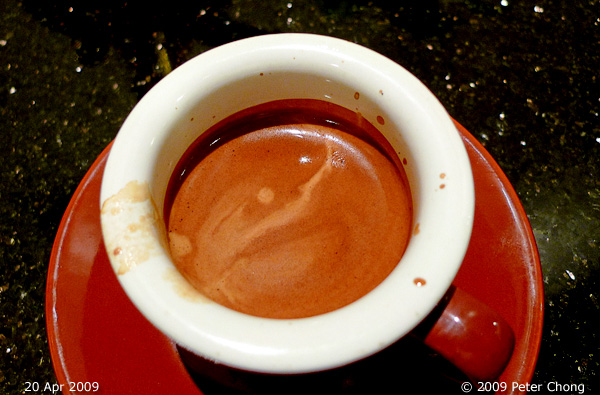
The resultant espresso doppio:


The creama is thick, good colour. The taste was lingering...good mouth feel, with a sharp tinge of acidity impinging on a base balanced with thick, liqourice like body. Rather delicious. Nice fragrance. Very long finish.

Monday, March 30, 2009

Cafe Weasel: Vietnam's answer to Kopi Luwak

Just came back from Vietnam...bought some green beans Weasel
coffee...apparently similar to Kopi Luwak, but less gross. Kopi Luwak is a special coffee offered by the Indonesians. Kopi Luwak is not only famous for its alledgedly superior taste and aroma, but also for its extremely expensive prices. For the uniniaiated, it is gross...as it is coffee from the defecated remains of the berries that are eaten by civet cats (Bahasa Indonesia Luwak). Apparently the Vietnamese version, the same civet cat (for some reason translated as weasel) ingests the coffee berrys, and partially digests the flesh...the beans in Kopi Luwak are defecated, but as I understand it, for Weasel Cafe is regurgitated. The special taste and flavour of the beans are attributed to possibly two factors...only the best and berrys are selected by the cats, and the digestive system enhances the flavour of the beans.

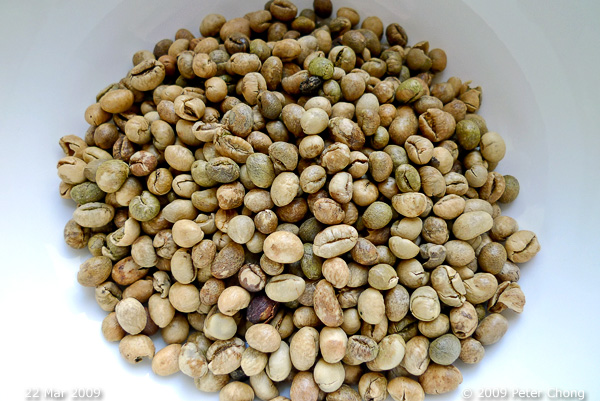
I am not sure which is nearer the truth, but the beans I purchased are almost 99% peaberries. Coffee are berrys, and each yield two half beans. In a Peaberry, instead of two beans, it develops only one. This is a biological anomality, the single bean becomes round shape, instead of the typical bean which is round, but flat on one side, where it faces a mirror imaged twin. Peaberries are treasured by coffee lovers because the flavours are more intense.

Drinking coffee in Vietnam is an favourite passtime of the locals. There were many cafes, in the vein of those in Paris along the streets of Ho Chih Minh City (Saigon) and Hanoi. The preferred method of brewing is with the ubiquitious filter perched atop a cup, where hot water is poured over the grounds and allowed to slowly filter through the device and collect onto the cup below, which is frequently lacecd with sweetened condensed milk.

The coffee is always very strong, dark, and have a vanilla taste. Rich and robust, it was quite a delicious cup.

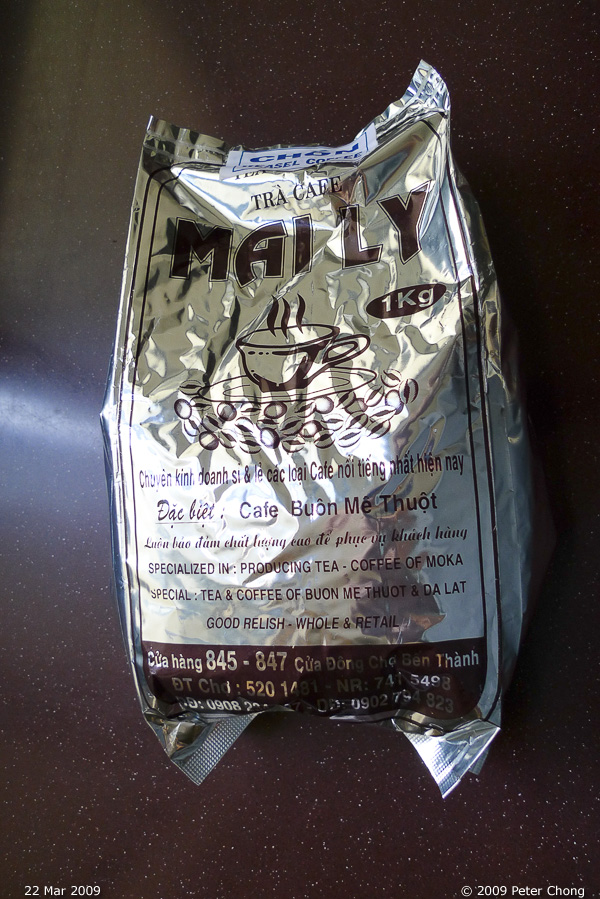
I purchased a kg of green beans from Mai Ly Coffee suppliers at Ben Thanh Market in Ho Chih Minh City.


This was the only beans available in green, and 1 kg costs US$10. Mai Ly also sells other roasted beans and also ground coffee. I met the owner Mai Ly herself, and she claims she roasts the beans herself.

From inspection, looks like peaberries, and the greens do not seem to have been sorted. When I poured out a portion for roasting, I discarded the blackened and shrivelled beans, and only used those which looked whole, complete and good.


As can be seen, mainly peaberries.

I roasted my first batch of about 150g. I made a mistake during the roasting. The roast profile is such that the first crack was very soft...so soft I missed it, and thought the second crack was first...by the time I realised that, it was too late, and I have over roasted the beans.

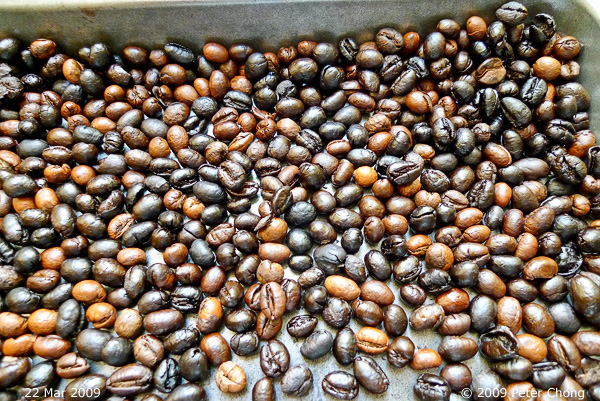
The resultant beans were full French roast, very very dark.


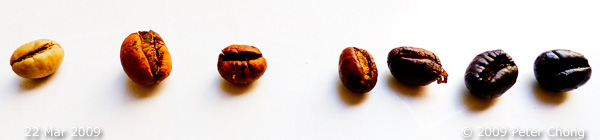
From left to right...greens, first crack, somewhere along, second
crack...final roast...as you can see very dark.


Note also, the beans were not uniformly roasted, and I suspect this is because of the variable quality of the greens.

Taste wise, because it was very dark roast, the character of the roast
took over, and the character of the beans are more or less lost. The
grinds needed to be much finer than my regular single origin beans to
get proper extraction. At the centre notch of my Mazzer Mini, the
coffee just runs through. Not sure if its due to over-roasting.

here is a video of the extraction on my machine:

Click here for movie

the extraction was quite ok...about 32s, slightly on the long side.
The volume is a bit high for a double espresso. In the video, you will
see the espresso start, then a steady flow, and it stopped, and
restarted...this is because on the Elektra Microcasa a Leva, a double
espresso requires a double stroke...so two pours.

The first 17 or so seconds is the pre-infusion. At about 18s, pressure
is released by the machine, and the piston forces water through the
grinds at 9 bar pressure. The first pour starts about 18s in the
video, stops at about 30s, and the second pour starts about 35s into
the video. The entire pour of double stops at 55s.


As alluded, the over-roasting made the espresso bitter. Heavy taste, no
specific flavours come out. In Saigon, the coffee using their filter
had strong vanilla taste. But my own roast, this was not apparent.
Bold coffee taste and flavour.

I will roast another batch when I return from Tokyo after Easter.

I may not be updating this blog for a week, as I am on vacation in Basel and Dresden...though I always hope to be able to update the blog when I travel, truth is, I often end up too tired by the time I get back to the hotel room, and the time change doesn't help.

Photonotes: This is the first post using a portable, smaller camera than my usual EOS 1Dmkiii. All photos were shot with the Panasonic Lumix DMC LX-3, a little camera, but very capable, as you can see with the results, as long as we keep the ISO below 400. The fast lens at f/2 helps get steady shots.

The video is also shot with the LX-3, one of the very first videos I have ever shot in my life. So pardon the inexpert handling, but the quality of the camera, shooting in HD, and reduced size to load faster is quite good.

Saturday, March 21, 2009

Oriole Cafe and Bar: espresso to satisfy at last...plus great food too!!

with Prof. Horolographer, SJX, RobG and DaveG

Had wanted to drop by for a long time, ever since I was alerted of the presence of this new eatery, chill out bar, espresso haven. Colin Loh, a friend from the Singapore Greens Group (a group of fanatic coffee lovers, home roasters, and espresso freaks) told me that John Ting, Singapore's Barista Champion 2008 and 2009 is resident barista has setup shop just across the road from my office...I yearned to go have a try.

I first dropped by during the First Latte Art Shakedown...discovered John and Oriole's owner Keith Loh (SBC 2009 second, SBC 2008 4th) were fun folks.

So this time round, I wanted to sample the food...

First off...some starters:

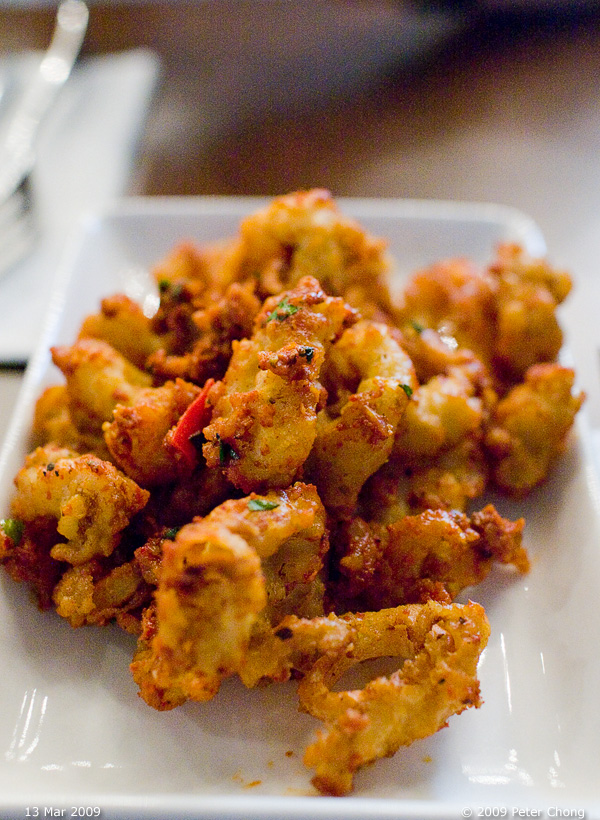
Spicy calamari.


These were rather tasty bits of calamari, battered with a spicy batter, deep fried. The calamari was a bit overcooked, and slightly tough, but tasty.

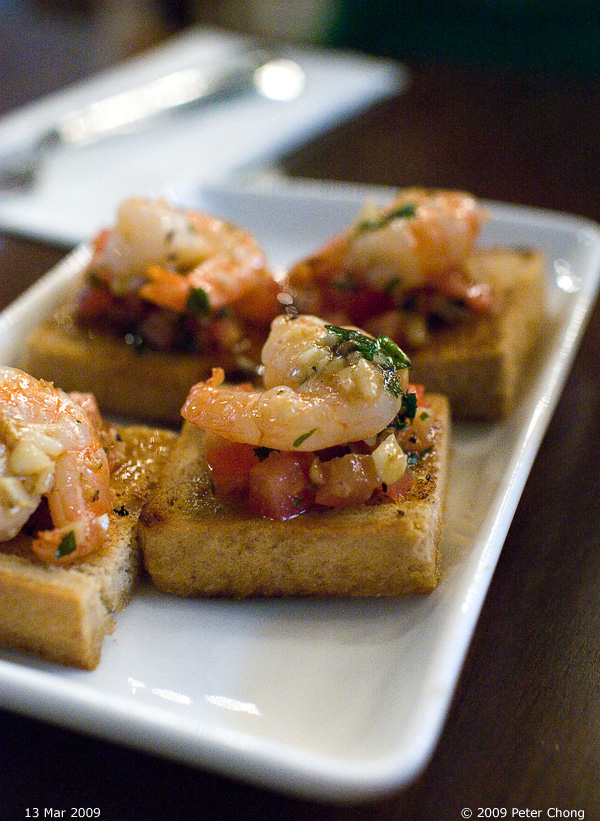
Second started was Grilled prawns bruschetta:


Interesting, methots...prawn bruschetta? Usually, in Italy, bruschetta is just plain grilled bread, topped with virgin olive oil, tomatoes, mozarella, and sometimes...if the chef is daring, proscuitto. This was my first encounter with prawns. But the prawns were fresh, the grilling very delecate...leaving the prawn in an almost raw state...so one can savour the prawn flavour and taste...and crunchy texture...very nicely done...the bread was crisply toasted, and the diced tomatoes provided some bite...goes well with the virgin olive oil drizzled over. Nice dish!

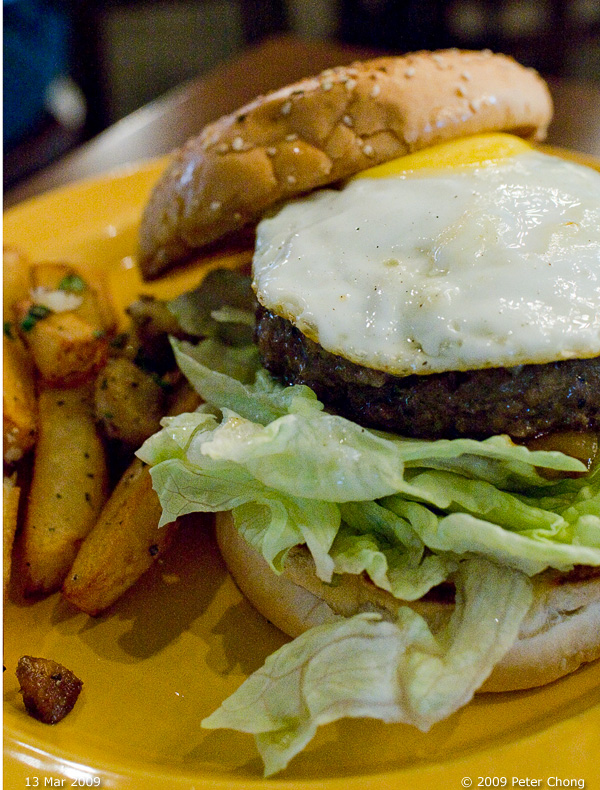
Now the mains. The young man of the group...12 year old DGan had the biggest entré: the burger...topped with a fried egg, it looked wonderful. He affirmed with big smiles, and approving looks as he devoured the burger.


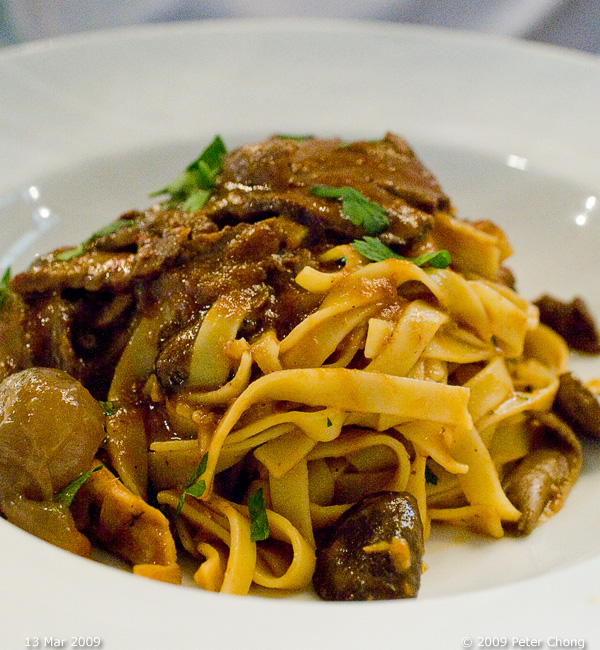
SJX had the braised beef cheeks with tagliatelle:


He too grunted his approval between bites. The beef looks very well braised in its own jus. One to try for a next visit.

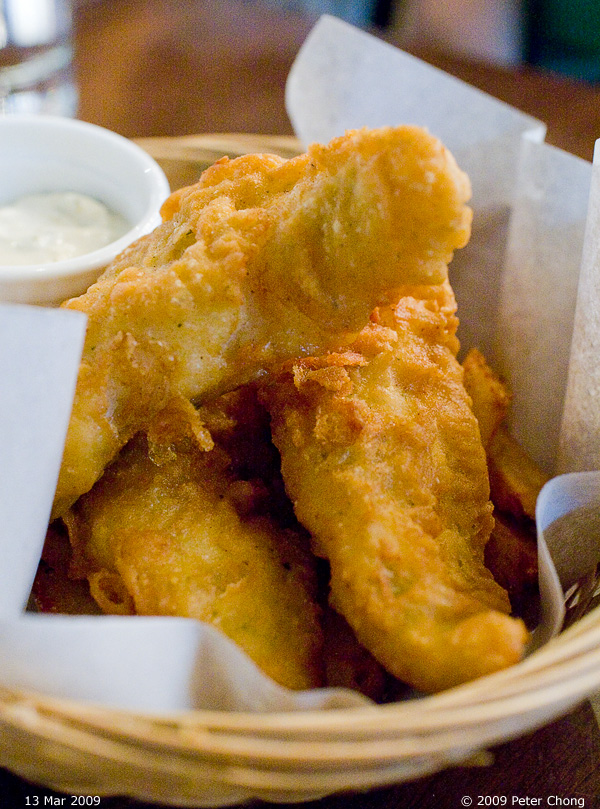
RobG had the beer batter fish and chips.


Fresh fish, I suspect snapper, is encased in a very crisp, mildly flavoured batter. The batter was made lighter by adding beer to the mixture and allowed to rise...allowing the beer to create within the wet batter, making the dough lighter, and when deep fried in hot fat, resulting in batter which is crisp, and provided the structure to contain the moisture of the fish within. The fish was tender, moist and full of flavour. Quite lovely. A simple dish, done right.

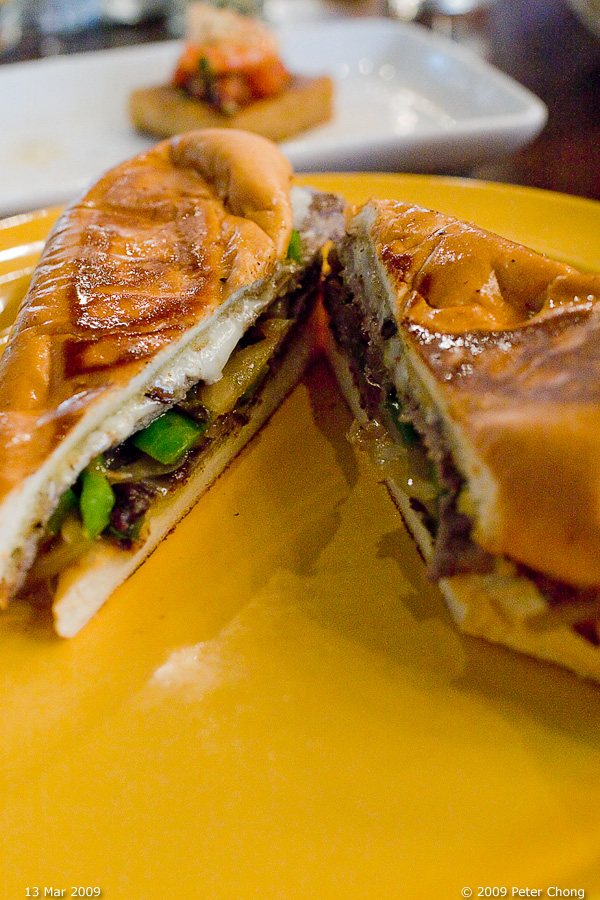
Horolographer and I both had the Philly Cheese Steak.


I always had a soft spot for Philly Cheese Steak. My first encounter was the now defunct (in Singapore...still doing well in the US), inexpensive, food court variety...a shop called Steak Escape. Edward loved the PCS as well, and often the two of us would sneak away from shopping...he would have been no older than 4, perhaps 5 years old then, to have a PCS. Later, in the US, I sampled the awesome Pat's King of Steaks in Philadelphia, who invented Philly Cheese Steak. Pat's (and Geno, which I haven't tried...but reports of poor service at Geno have discouraged me...) are the hallmarks to judge by. My memory of Pat's is good...though I didn't like the cheesewiz. There is something primal about eating a sliced rib eye in the concoction of onions, provolone cheese, fried in tallow/butter and a soft, toasted long hoagie bun.

The Oriole version was excellent...albeit a bit on the small side...the bread was soft, nicely toasted...not too crisp, but enough to provide some bite, the insides were smooth and soft. The beef...I think ribeye like at Pat's...was sliced, fried, and rolled into a neat pile. Onions were beautifully caramelized and some green bell peppers were added. I am not sure if they used Provonce cheese, but the cheese tasted good, and I was thankful no Cheese Whiz. Both Horolographer and I loved it. I would go back just for this sandwich.

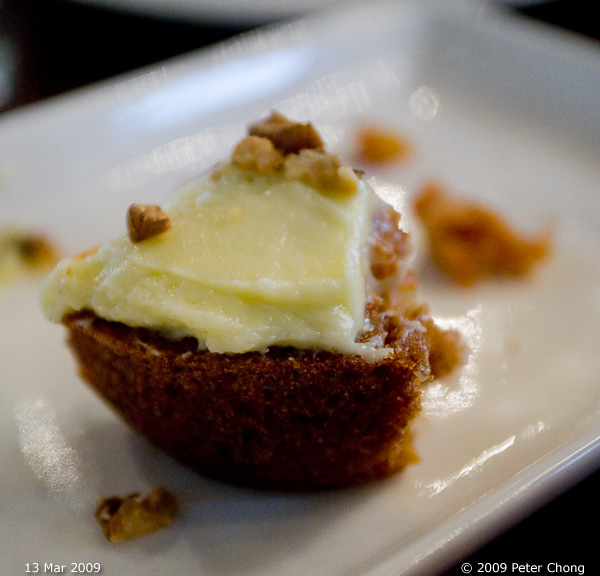
For desserts, we shared a Chocholate Fudge Cake, and a Carrot Cake. The Choc Fudge was super, super rich. Didn't take a pic...was a rather largish slice. The carrot cake was about the size of a regular cup cake...


My slice, showing a nice generous icing was rich, and creamy. The cake itself was moist, yielding small chunks of carrot bound within the cake. Very nice. Reminded me of the original Carrot Cake offered by the original Coffee Club way back when they first opened in Holland Village in the early 1990s. Both Oriole's cakes were a tad too sweet for me.

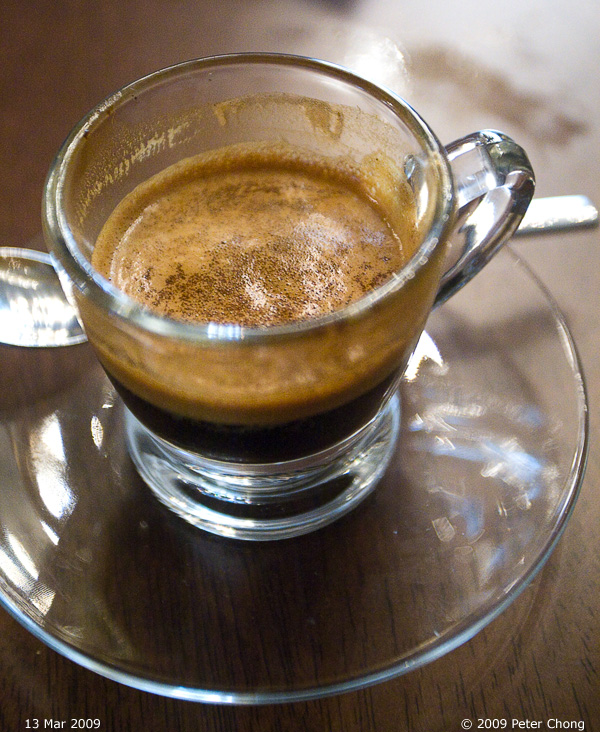
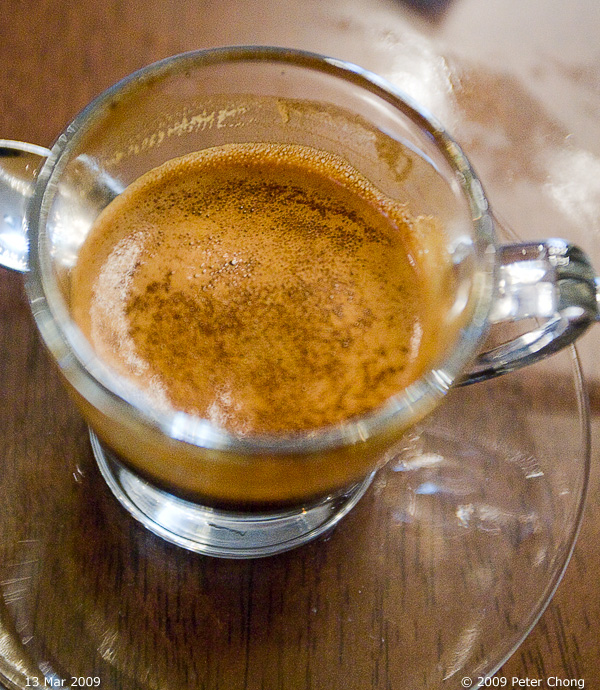
And finally the coffees. The piéce de résistance...the espresso. This was my espresso doppio:


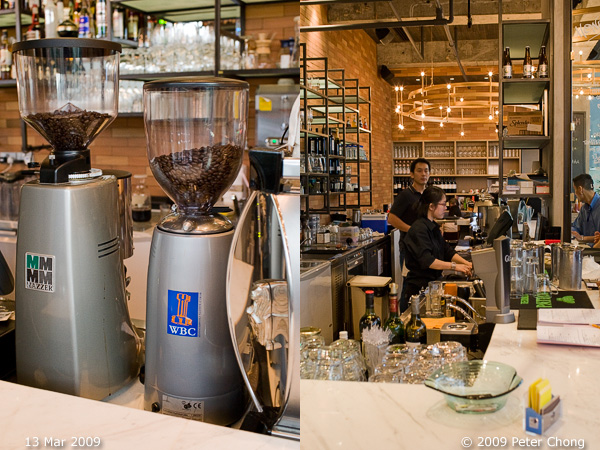
Nice thick crema, moulting on the crema suggest a good cuppa. I did not see my cup being pulled, but I went to the espresso machine. Saw a mother of a machine...a 3 group La Marzocco, and a smaller GS3. Beautiful machines.


The heavy lifting...um, brewing, was done by the magnificent 3 gruppa La Marzocco. The resulting coffee...best in Singapore...befitting that it was pulled by the Keith, who placed no. 2 in Singapore Barista Championship 2009...as mentioned, John Ting, who also worked in Oriole was placed no 1, but he was in Reservist.


Even though the glamour is always stolen by the espresso machine, the grinder is the most important piece of the espresso equipment puzzle. Get the grind wrong, forget about espresso. Two very large grinders were took pride of place. One was a Mazzer Super Jolly (I use the Mini myself at home). A big grinder is better than a smaller one because larger grinders operate at lower burr speeds...translating to a smaller amounts of heat generated by the grinding...resulting in helping preserve the flavour of the grinds better. Each cup was ground to order. This ensured that the coffee is fresh, and never stale. Ground coffee have a shelf life for the connoiseur of about 1 minute. Beans must be ground for each cup, immediately before brewing.


The volume was just a bit long for a doppio...but still within regulation size. An espresso should be about 1 fl. oz in size...and a doppio (double in Italian) should be no more than double the size. The crema held a spoon of sugar for about 30/40seconds, testifying to the fact that it was a result of correct brewing and not a gimmick. Proper crema has foundation and structure, and can support a teaspoon of sugar for a while.


The coffee was viscous, almost liquorice like. Superb mouth feel, good body, beautiful aroma and a long after taste. This is actually very very good espresso. Mecca in Sydney (at Grace Hotel's side by King Street) serves a more potent version, but the Aussie version achieves this by actually serving a double ristretto...when you order an espresso doppio. The espresso made my day!


Oriole Bar and Cafe
96 Somerset Road
#01-01/05
Pan Pacific Serviced Suites
tel: 62388348

Keith also owns Bedrock Bar & Grill just adjacent...a fine dining establishment.

Photonotes: The restaurant was rather dark, so I had to shoot at ISO6400 to ensure a shutter speed, with my preferred aperture for sharp hand held shots without IS.
I think a bit grainy, but still acceptable...do you think so?

Sunday, August 24, 2008

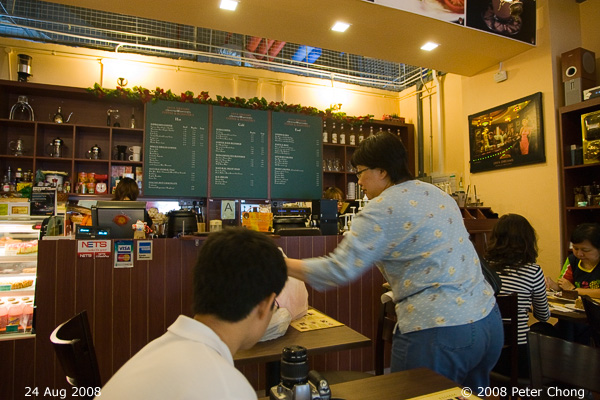
Java Dreams, The Central

Peter's comments in italics.

You know how it is with some places (or people) that you find you can just "click"" with at the first encounter? Well, that's what happened for me at Java Dreams Coffee & Roastery (B1-46, The Central) on this rainy Sunday afternoon...


Ok, I'm not a real serious2 coffee afficianado (like me dearest hubby) but I do need my coffee almost daily, and I do like good coffee places with the right feel and of course, the brew itself must live up to expectations. So after a pretty good lunch at Central, hubby, son & I, decided to give Jave Dreams a try.

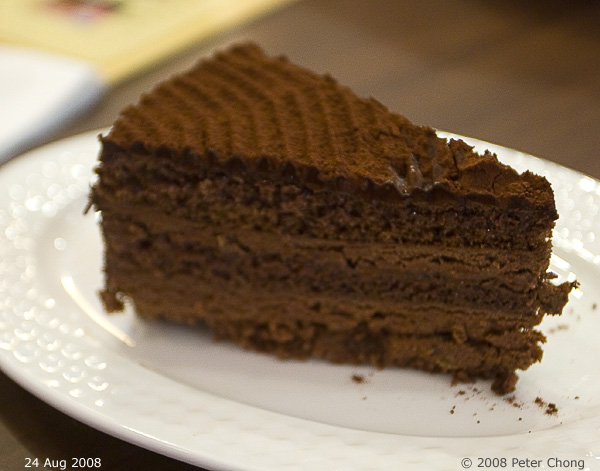
Hubby ordered his usual Espresso (double shot), I ordered a Cappucino and we also decided to try a piece of their Chocolate Truffle cake.

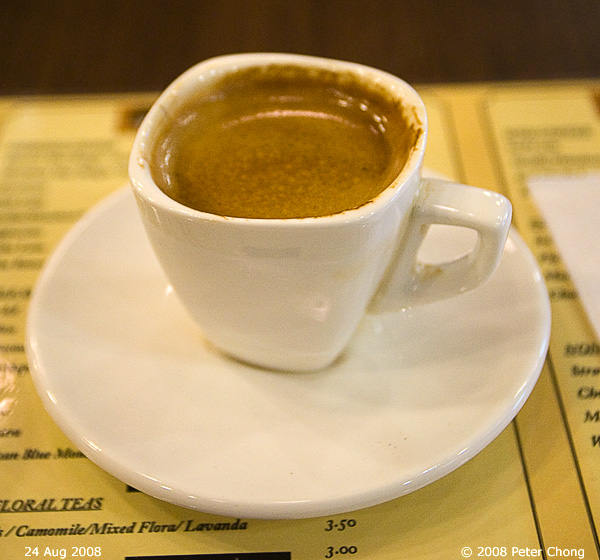
The espresso came larger than one expects. It was not quite up to hubby's standards. He felt that the coffee beans may have been over-roasted but finished it nonetheless.


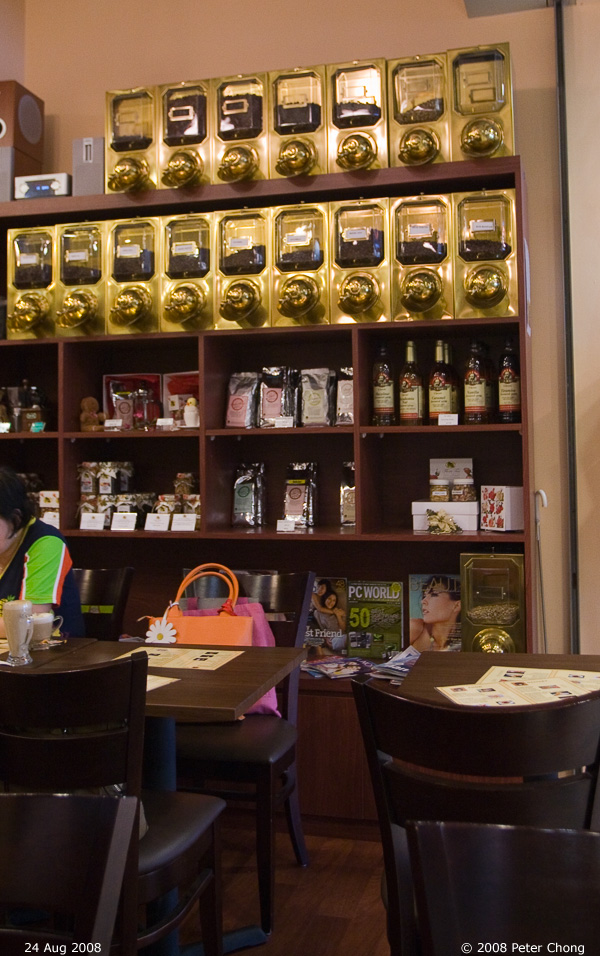
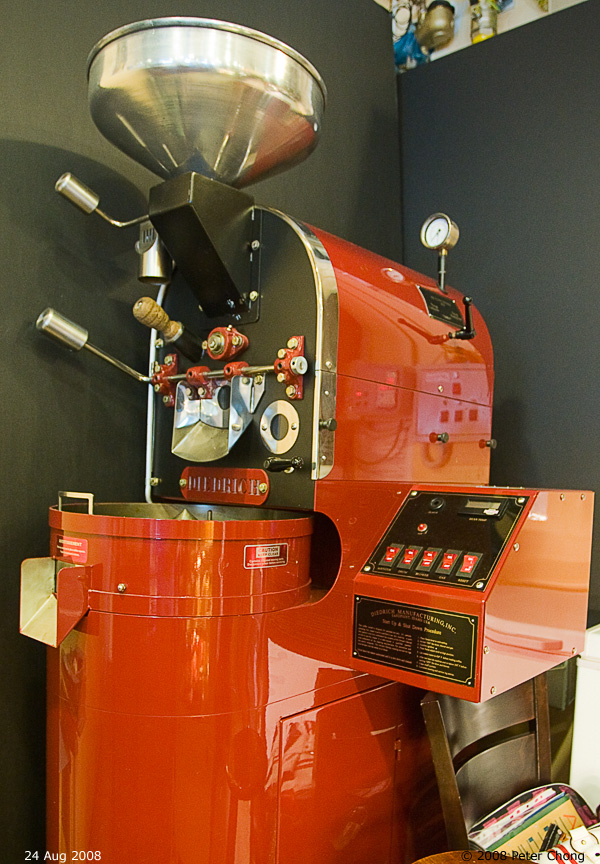
For a store who takes the trouble of roasting their own coffee...check out the Die Dietrich roaster in the corner. what a beauty! This raised hopes...unfortunately, too high. I don't know what they use in their blend and who the roastmaster is, but the results are a bit disappointing. The coffee displayed in vats on a wall looked over-roasted...the beans were oily, and very dark. I also spied a vat of green beans on the lower right.

A picture of the gorgeous roaster.


The espresso machine is a high tech, computer controlled 2 group affair by Nuova Simonelli - looks like their Premier Maxi. A machine which should be capable of hammering out excellent espresso all day. Temperature control should be spot on, group pressure perfect, and if barista technique is equal to the task, the espresso should be syrupy, concentrated, with great mouth feel and show an excelelnt head of crema - reddish brown and characterised by some tiger striping. See earlier post on espresso lessons.


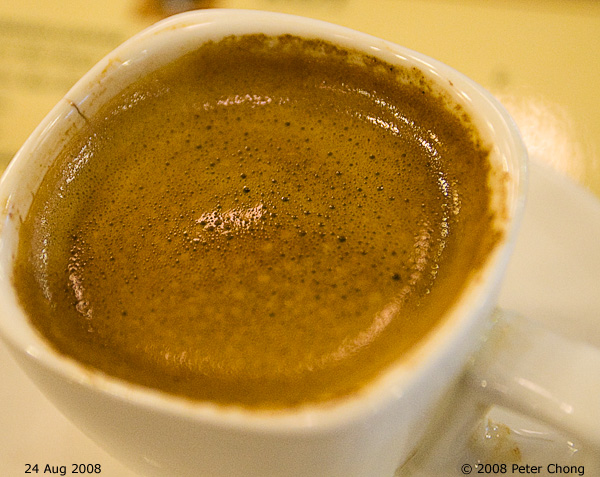
This double shot tasted consistent with an over-roasted bean - bitter, bland, lacking body and had poor, thin mouthfeel. Also, the crema was very thin, in a pale colour, indicating over-extraction...also evidenced by the large volume of the shot.


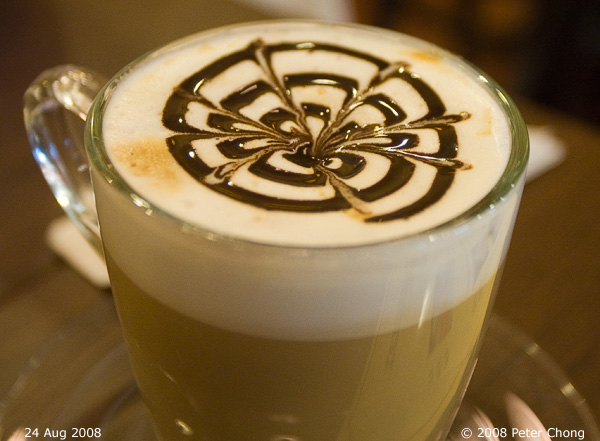
My cappucino,on the other hand, was quite pleasing to the eye and this was because the barista dressed it up with choco-latte art! (see picture, see picture!!).


This ain't excatly truly Ally McBeal-frothing and moustche-making style cappucino, but hey, who caress when its good-looking! After sipping it, chocolate well-stirred in, I found this capp. tasted pretty satisfying and not too bad at all.

A strict cappucinno would not have chocholate syrup added - a traditional Italian barista would freak out (!!...he would also freak out by a customer ordering cappucinno after breakfast time...Italians only drink espresso after breakfast cappucinno...but that's another story)...so I would classify this as a mild latte mocha, rather than cappucinno. The latte art made by the chocholate syrup was quite nice...the spider's web was crisp, and well defined. Nice.

As for the chocolate truffle cake, it was less rich than I had hoped for. But it was good enough to get son, Edward, interested and happy in polishing it all up. It was, rather a bit more moist than the picture suggests.


All in all, it wasn't so much that the coffee and cake were to "die for", but there was something about this small cosy cafe that "clicked" for me today. Perhaps it was the lazy jazzy Norah Jones croonin'away. Or perhaps it was the unpretentious big red coffee roaster placed inconspicously at the corner, not out at the front centre of the shop. And a couple of colorful coffee-themed posters (one had "Whole Latte Love" on it) casually on one wall. Nice. Very casual and unobtrusive, as a real good coffee hang-out should be.


Best part was, it wasn't chock-a-block packed with noisy people like your every other self-service coffee shop in town. That's what probably did it. The place allowed me and my best guys to take our time to sip our cuppa, flip some magazines (as did son after cake was wiped off plate) and basically, just kick back and enjoy the moment. Aptly named "Java Dreams", this place could certainly make one forget the hustle and hurry of life for a while with its quiet ambience and pleasant smiling staff who remained discreetly behind the counter but were there to respond when you needed them. Unlike some haughty local cake and desert places which refuse to serve one water for free, even if you're paying gastronomical prices for its cakes/pastries. Iced water here was given freely and happily when asked for. These were the small things that made for a great relaxing time when hanging out here with family/friends. I hope this place doesn't become another coffee place turned Starbucks later. I hope it remains this casual and cosy enough for one to slip into, hold and sip that cuppa for a while and be lulled away into Java Dreams..zzz.

Java Dreams
6 Eu Tong Sen Street
#B1-46, The Central
Singapore

Thursday, June 12, 2008

The art of espresso

By Peter Chong and Thanet Makjamroen. This article first appeared in the Food and Drinks Forum in The Purist and also in Timezone.com.

Alternate title: Great lessons in espresso from Prof. Thanet.

Abstract: I spent a good part of the afternoon at my espresso teacher and good friend - Khun Thanet’s home, and learnt a great deal about roasting, grinding, and making excellent coffee.

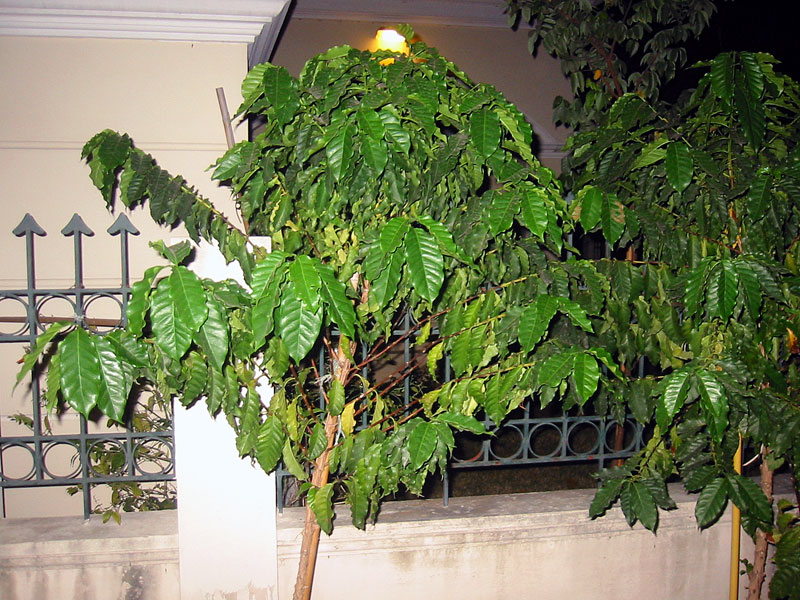
The coffee tree outside his house tells us he is somewhat serious about his coffee…


We begin with fresh green beans. The beans have a greenish, grassy smell, quite unlike coffee. The beans are dry, and nutty to the touch. The beans are very high quality Arabica beans from the Doi Tung estate in Chiang Rai, Thailand.

The name of the place Thanet gets his coffee is, in full, Doi Tung Development Project of the Mae Fah Luang Foundation. It is a royal initiative project of Her Royal Highness the Princess Mother. About ten or fifteen years ago the Princess Mother built a private residence on a hill in Chiangrai that was clear cut and the surrounding hill tribes people had been living in very poor condition. She then turned the dry hill into rich verdant forest with plantation of coffee, macadamia nuts, strawberries, and flowers. Now it is one of the top attractions of Chiangrai. The hill tribes people are hired to work in the plantations and trained to weave cloth, make carpets and pottery. Their standard of living improved dramatically and they do not have to earn their living by growing poppies.
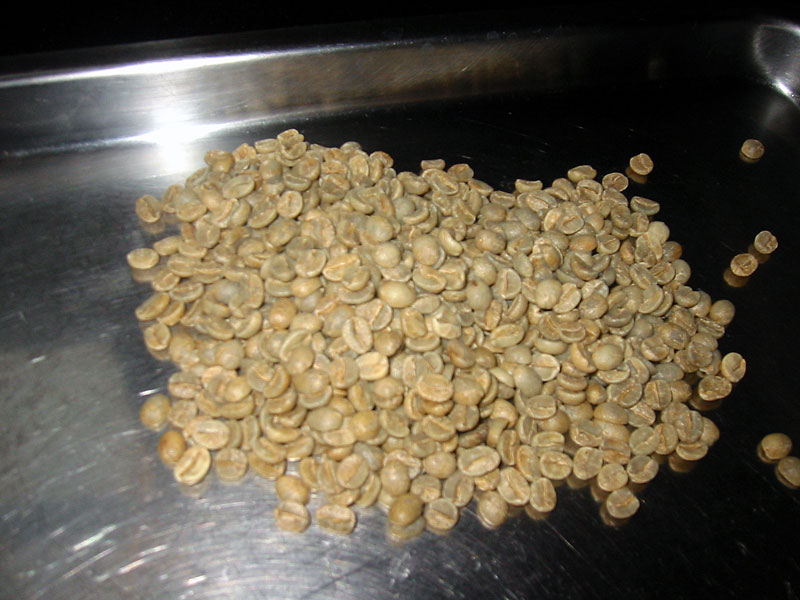


Into the specially designed home roaster it goes!

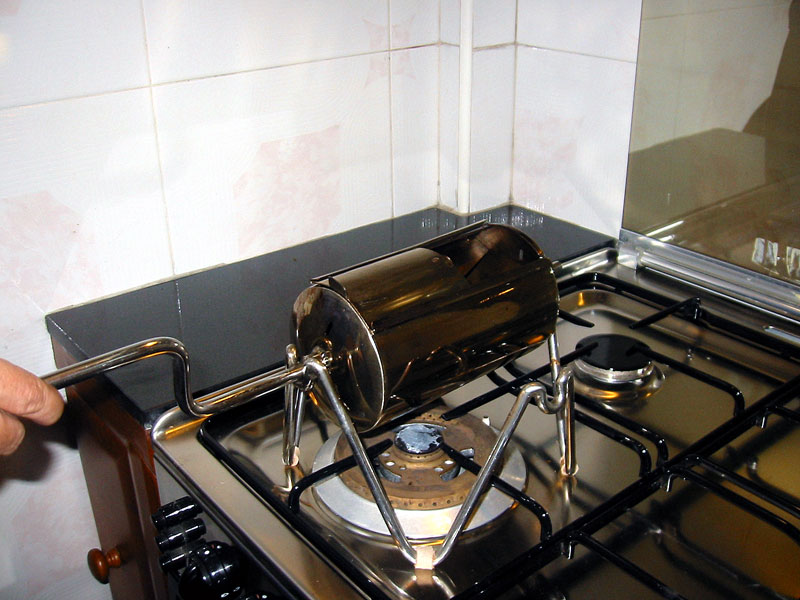
This home roaster is made of stainless steel, designed by Prof. Thanet from books and literature of traditional designs. I still use the very same roaster. Thanet, however, has gone to a 5kg batch roaster, which is gas fired, and rotated by an electric motor.

The simple roaster comprises of a cylinder, attached to a handle. The insides contains fins, which agitate the beans as the cylinder is rotated. In the picture below, the hatch is opened to fill the cylinder with beans. It sits on a very craftily designed set of legs, and goes over a gas stove. Very well built.

Special roasting instructions by Prof. Thanet in conjunction with me. I started roasting in 2002, and Prof Thanet in 1993.

1) Sort through the beans to discard black or deformed beans, impurities, stones, etc. Stones can wreck your grinder.
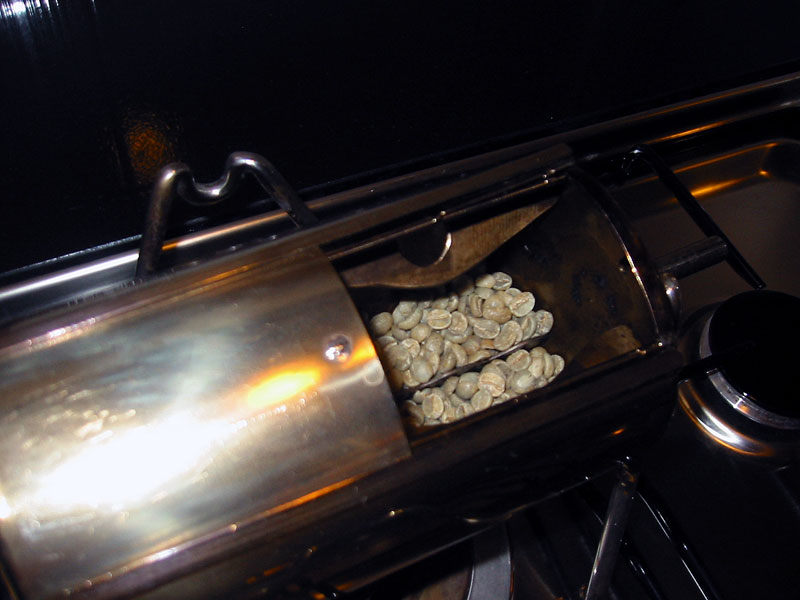


Gentlemen, start your engines…let the roasting begin.

2) Put the green beans into the roaster. Do not use more than the third of the volume of the roaster. In this roaster, this should be no more than 250 grams. This is because the roasted beans is larger in volume than green beans, and you want to have enough space to keep rolling the beans inside the roaster.

3) Put the roaster on top of the stove. Use medium heat. What is medium? Use the heat level that will finish the roast within the 12-14 minutes range. For example, if it takes too long, turn up the heat the next roast. A larger amount of coffee beans also prolong the roast. So if you use a lot of beans you have to compensate the heat (higher) so that the roast is still done in 12-14 minutes.

4) Make sure that you keep the turning the handle at around one round per 2 seconds. Never take the roaster away from the fire before the roast is done, otherwise the roasted coffee will be bitter and have off flavor. Wait for the first crack that should come at around 9-10 minutes. The chaff will start coming out and change the color from tan to dark brown when the roast is almost done. Then the crackling sound will die down a bit, and the second crack will start with fervor. You have to estimate the roast from the intensity of the smoke coming out of the roaster. I stop when the smoke just starts coming out like the jet of steam from the spout of a kettle when the water is boiling. Of course, you can use a spoon to knock the door of the roaster to see the color. But do it quickly and keep the roaster on the stove all the time. Look for the color just a bit lighter than what you want. After you stop roasting the color will be a bit darker. The aroma will help you know when it is done as well. The color of the smoke, if you observe closely, will change from white to white with a yellow tint. Don't worry if you burn the first batch. We all do. You will get the hang of it in after a few times and then the roasting will be as simple as boiling water.


The roasting process takes all of 12 minutes, during which the beans grow some 50% in size, and undergoes what industry insiders call two cracks. The first cracking, referring to the sound the beans make as they split open under the heat…not unlike the cracking of corn to make pop-corn. At this point, chaff begins to be blown out of the ventilation openings. As we continued to the second crack, smoke pours out of the ventilation openings in the roaster. And we turned out the heat, and pour the beans onto a tray to cool.

5) Once the roasting is done, the next problem is how to cool the beans as fast as possible to stop the roasting. Some people use water spray. I never try that. I just put the beans on a metal tray and pour water around the outside of the tray. You can use it to make coffee after it cools down, but I think it is better to wait at least a few hours.

6) After roasting, rinse the roaster with tap water. You do not have to use soap. Just be careful that the roaster is extremely hot.
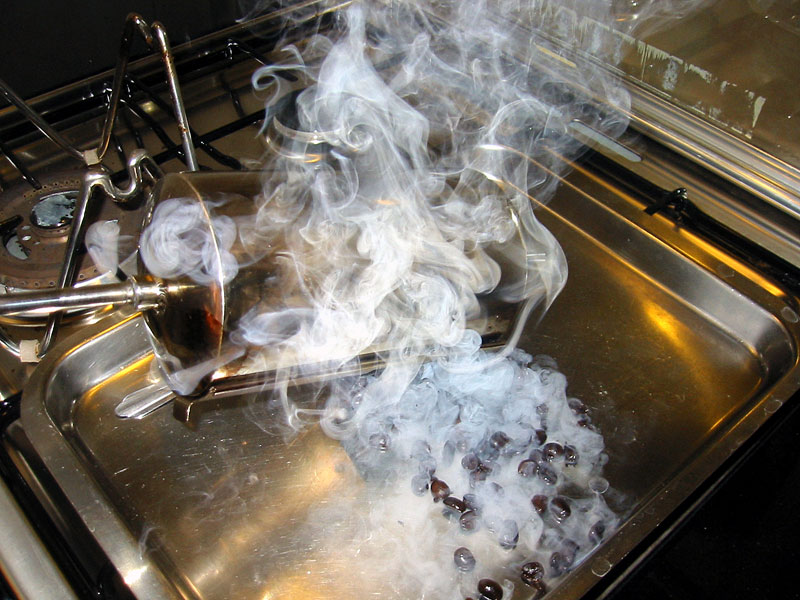


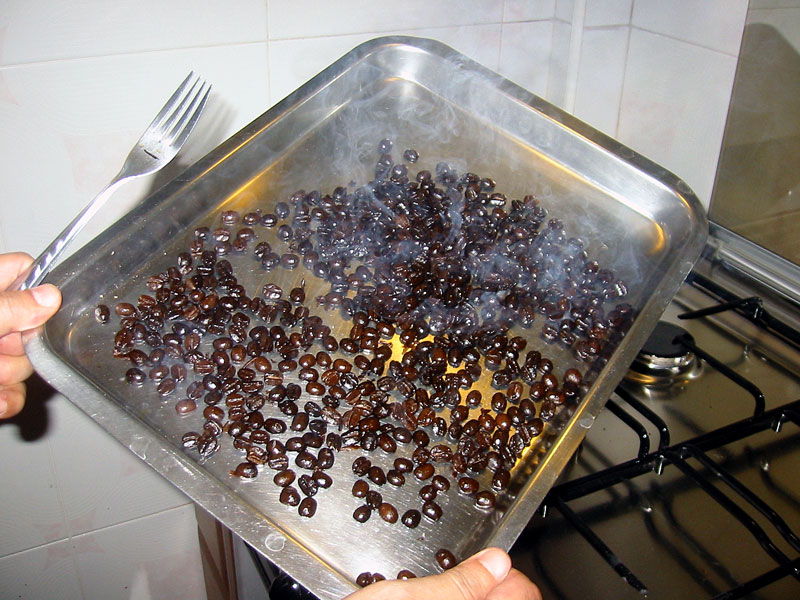
The roasting process causes incredible complex chemical reactions to the beans, not completely understood…but after the roasting, the beans are transformed. Note the oily complexion of the beans. The beans continue to cool, and give off generous amounts of gas.
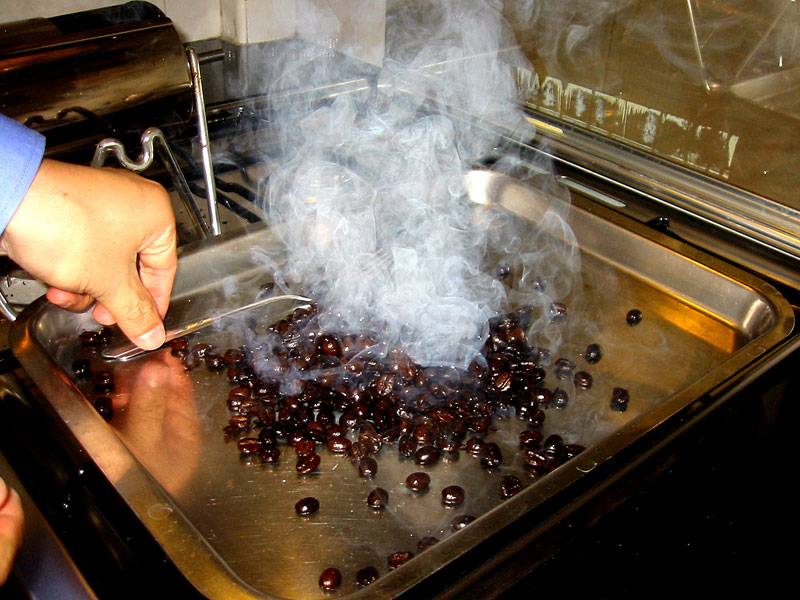


After some cooling, the wonderful aroma begins to fill the room. The picture below shows the final product…beans roasted to a dark brown complexion, suitable for espresso.

The color of the roasted beans may not be as consistent as what you get from specialty coffee shops. But I think a slight inconsistency of the beans contributes some complexity to the flavor. The quality of the beans and ability to roasted coffee may not be able to compete with the specialty shops, but the freshness more than make up for it.


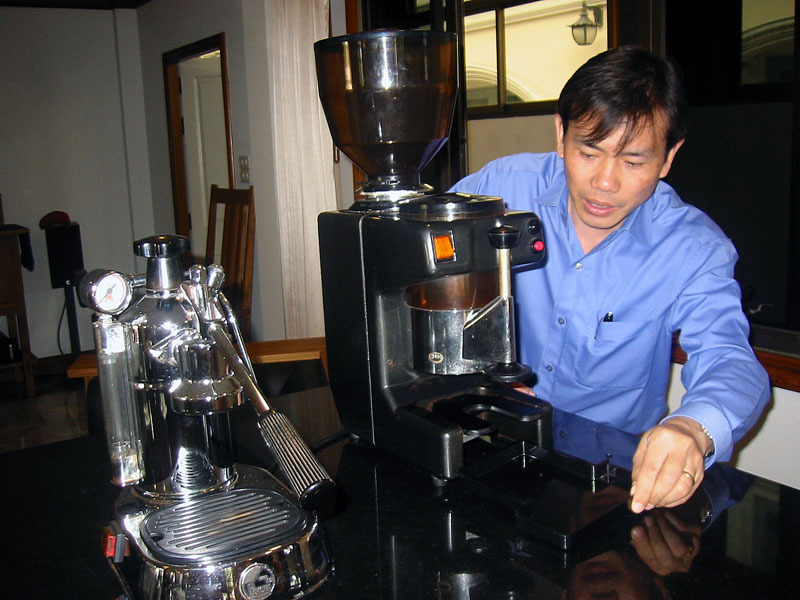
And we are ready to make our first cuppa of the day. First a survey of the apparatus for coffee making…seen below. On your left is the La Pavoni Professional, and on the right is the commercial grade burr grinder, also made by La Pavoni, and far right, is Prof Thanet


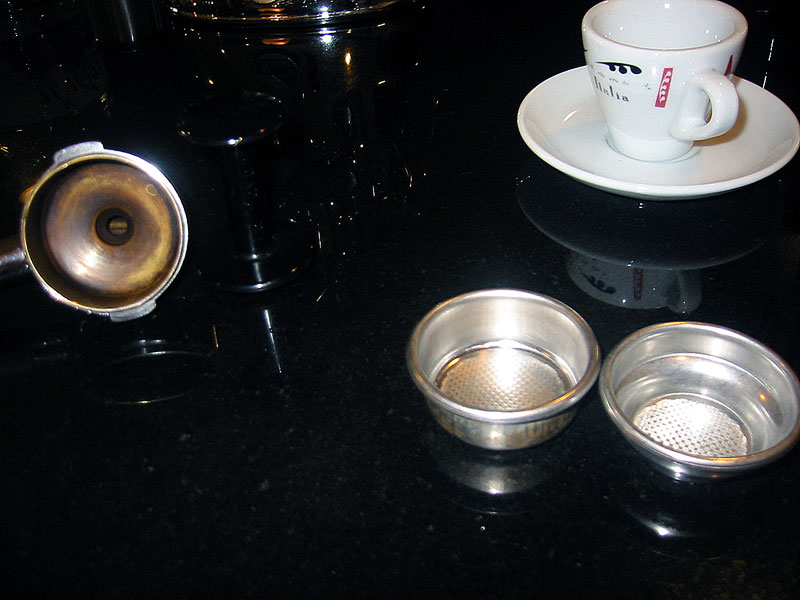
The gruppa (group head in Italian) at the left, removed and ready to receive the porta filter. Two porta filters are shown at bottom right…these are the two small cups which will contain the coffee powder for brewing. Note also the thick walled, demi-tasse cup at top right. It is important for the cup to be pre-heated, and thick walled to retain the heat…otherwise the crema will disappear quickly.


First, we fill the machine with bottled water. Tap water will work, as long as it is not too heavily chlorinated, as this will kill the taste and affect the crema of the coffee. Most experts say distilled water tastes flat.
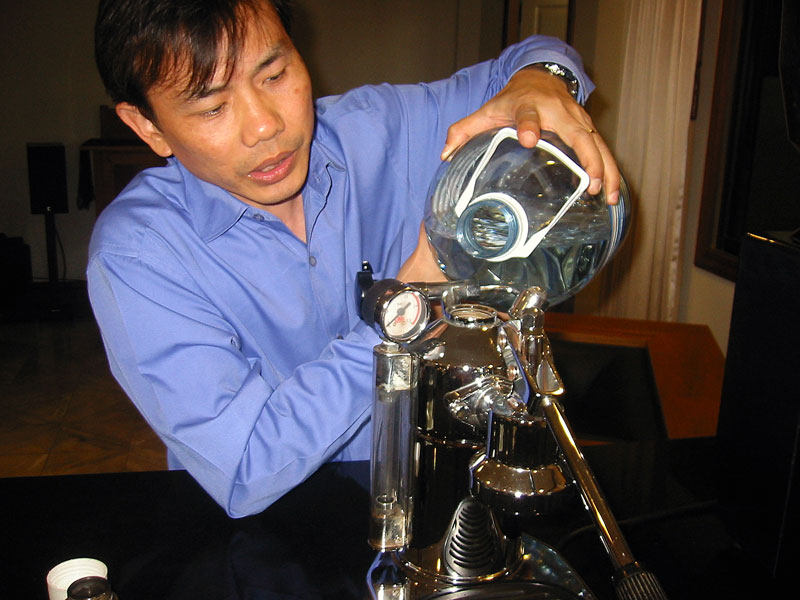


The machine heats the water to 120C, under some 1.2 bars of pressure. Before making the first cup, we pull the first blank shot to warm up the gruppa and warm the cup. Note towel on Khun Thanet’s left hand…the portafilter is empty, and sometimes the hot water can rush out when the lever is lowered. Also, future cups can be warmed by having a small amount of water in a cup, and heating it with the steam wand.
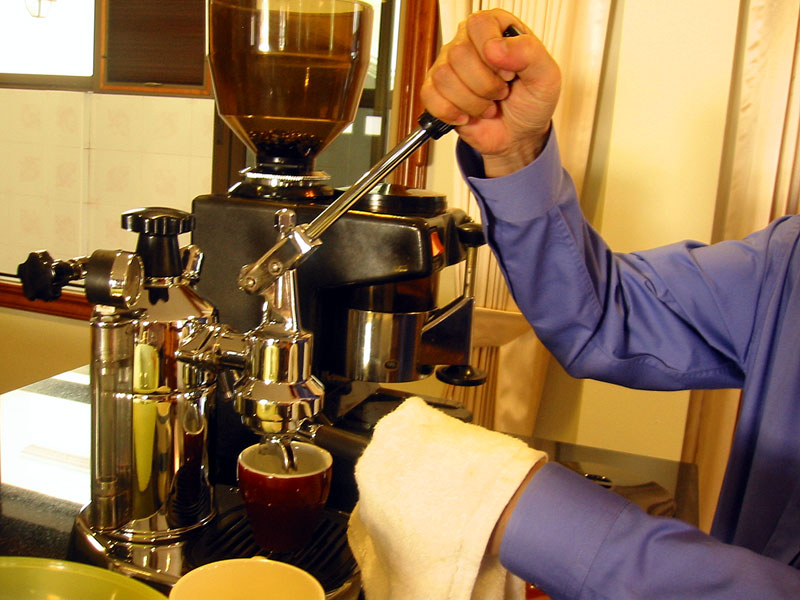


Machine suitably warmed…at this point, the La Pavoni’s pressure gauge shows 1.2 bars of pressure. We begin to grind our freshly roasted beans. The burr grinder does its job silently, and beautifully. Note that a blade grinder used for blending foods in the kitchen is not up to the task of grinding the beans. The blade is too rough to the fragile beans, tearing and crushing them, instead of minutely shaving the beans. The grinder is even more important than the coffee machine…so one needs to take great care at purchasing one.
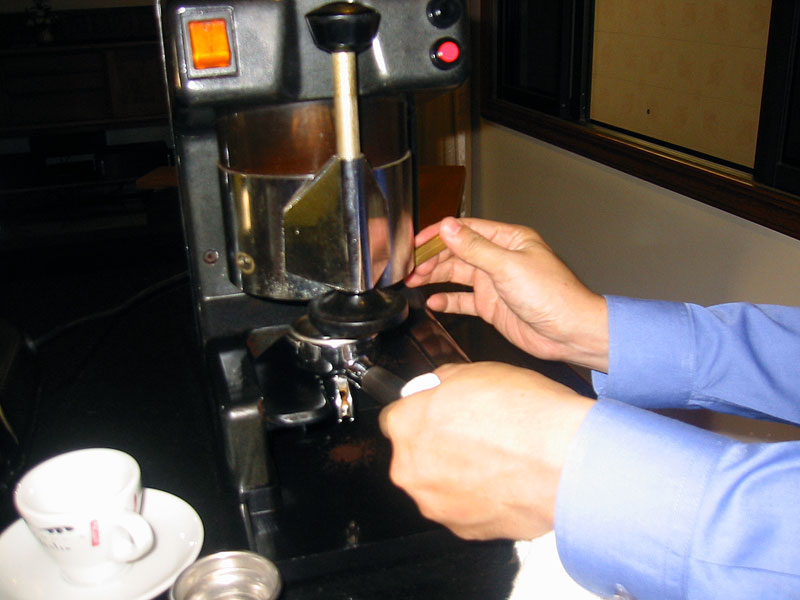


Dose sufficient to make a small mountain on the gruppa. Note the dosage counter on the machine…as this is commercial machine, intended for use in cafes…it allows the owner to count the number of cups made…also useful for maintenance purposes. Also note that the built-in tamper (black object partially blocking Khun Thanet’s right hand…is much larger than the gruppa of the coffee machine…it is designed for the larger gruppas of the commercial machines.
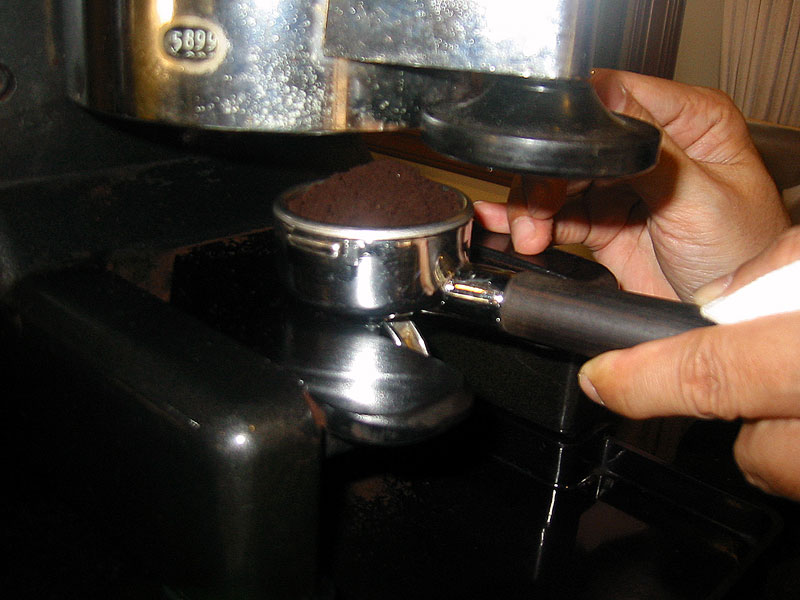


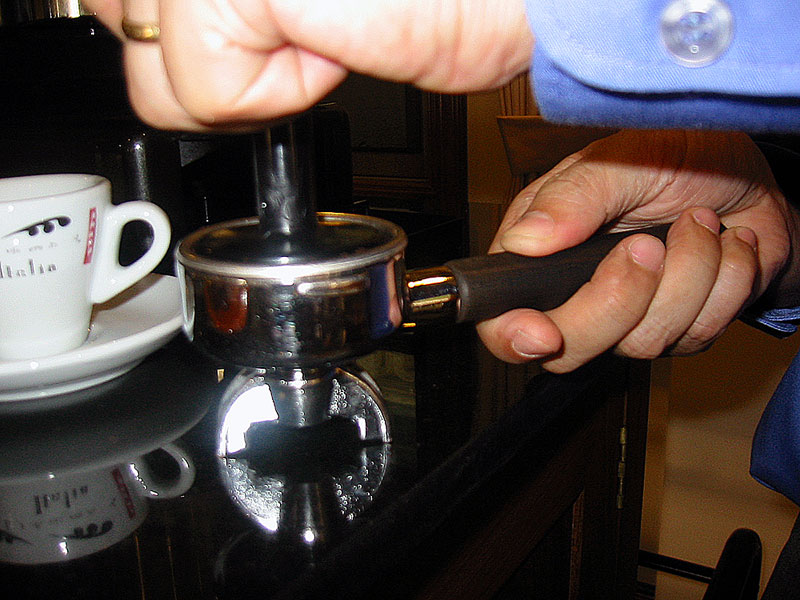
Then, the great tamping debate…Khun Thanet recommends just soft tamping, and polishing the grounds as shown below. Tamp only to ensure the grind is evenly packed, the top is level. But some other experts recommend 35 pounds of pressure in tamping. We tried a harder tamp later in the afternoon, and I found the resulting coffee so tightly packed, that it was too difficult to pull…I estimated I must have exerted some 60 pounds of pressure on the La Pavoni lever to pull a shot.


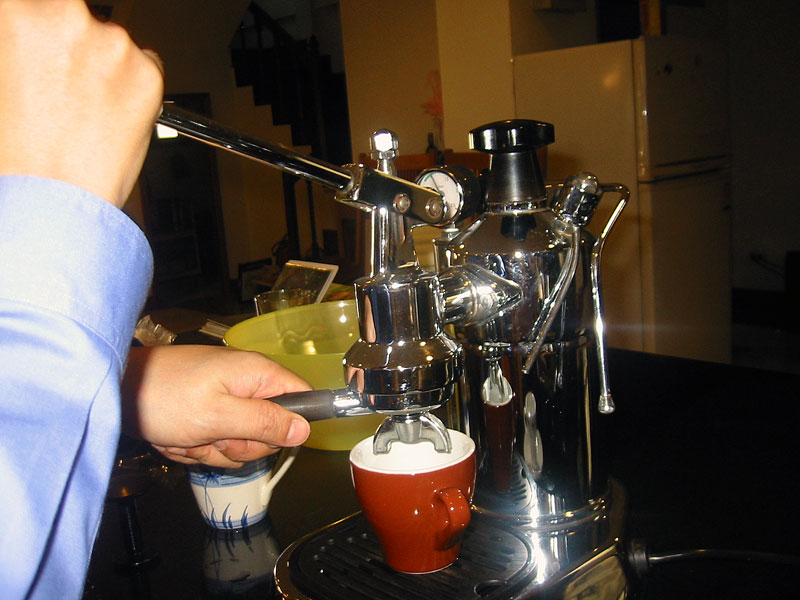
Into the La Pavoni it goes, and raise the lever. At the top of the travel, we hear the sound of water rushing into the gruppa, and we count 10 seconds to allow the water to pre-infuse the beans. At 10s, we lower the lever. Some 30 pounds of pressure is required to lower the lever, to create the 9 bar of water pressure required to extract fine espresso.


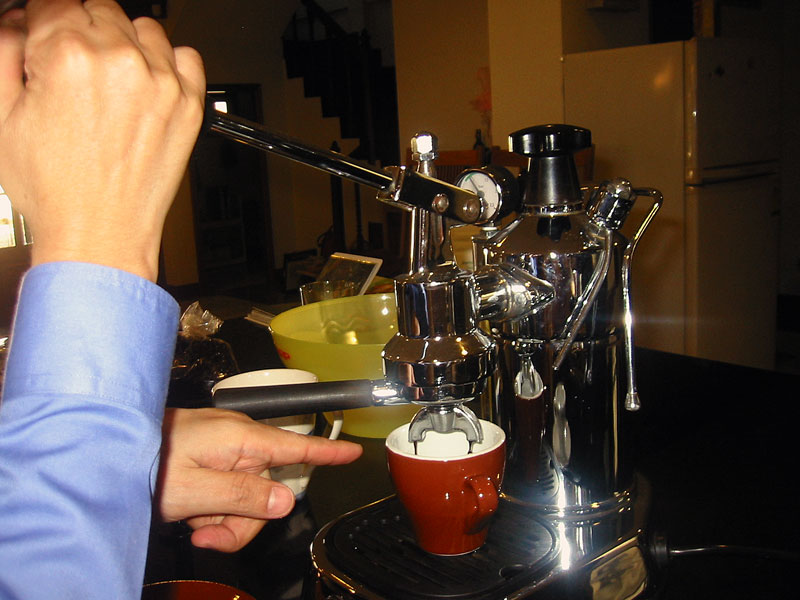
As we pull the lever down, a piston within the machine forces the hot water through the beans and out comes coffee! The coffee must take exactly 25 seconds to extract…longer, and we will have weak, over-extracted drivel. Too short, and we have under-extracted espresso…lacking in good crema and aroma.


Ah…perfect cup. Beautiful crema, wonderful aroma. Very syrupy, well balanced taste.
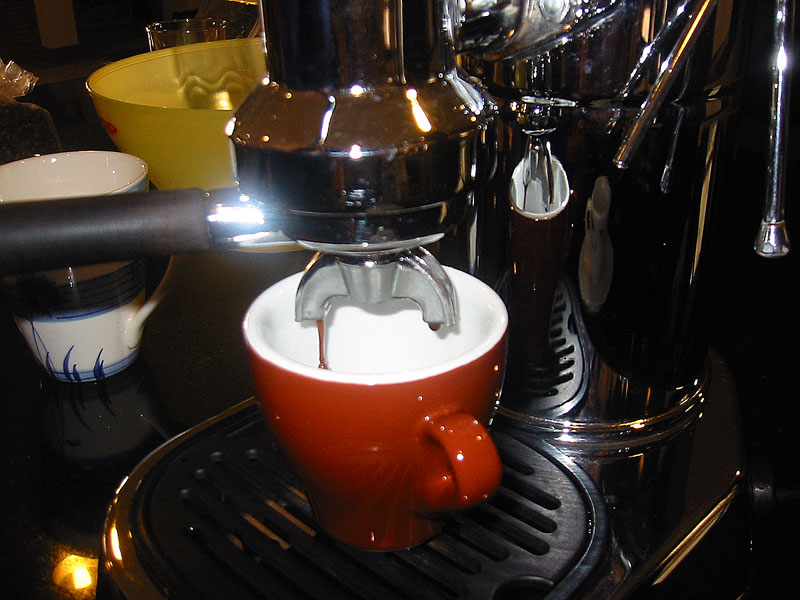


One great cup deserves another. I pulled this cup shown below. Note the crema is composed of tiny micro-bubbles, with a rich, foamy texture. The color of the crema is a rich brown. A teaspoon of sugar can sit nicely floating in the crema for more than 10 seconds. Nearly perfect!
Note the ring halfmoon of white is from the flash, reflected from the white walls of the cup, and not white crema, indicative of over-extracted coffee.
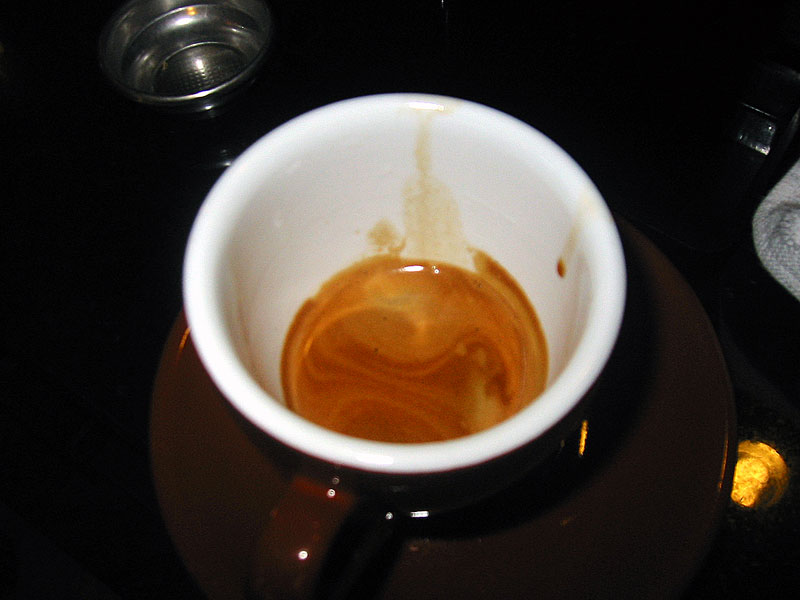


And I drank it! Note the crema still persists, sticking to the sides of the cup.
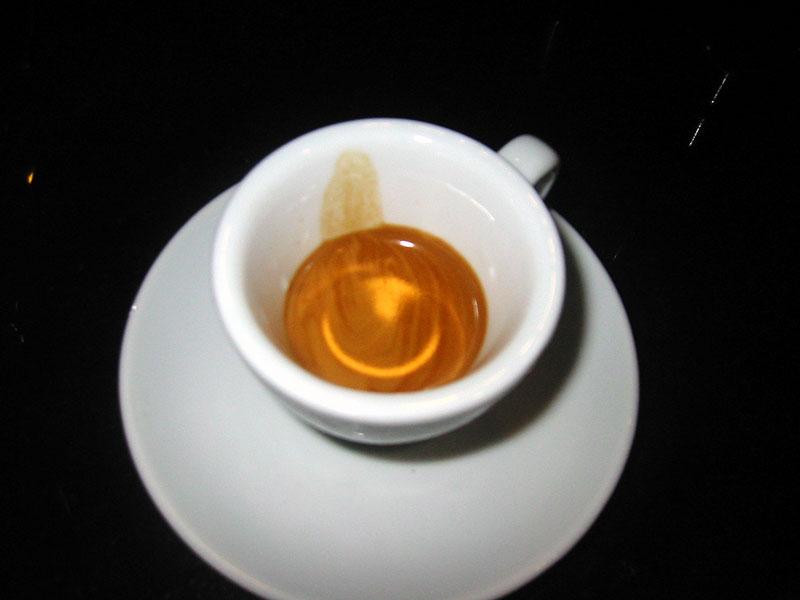


After enjoying the coffee, and allowing the machine to cool down, we removed the gruppa slowly, first allowing the steam and pressure to release. And then knocking out the spent coffee, which has been compressed into a hard puck:


Krap khun kraap.
©Copyright, Peter Chong…Bangkok, Feb 5, 2003.


My own setup is the same as Prof Thanet's for roasting. But I use a Mazzer Mini for grinding and an Electra Micro Casa A Leva, also a lever machine, but one which uses a spring loaded lever.