Showing posts with label otak. Show all posts

Monday, February 2, 2015

Onya Sayang: Peranakan food in Paya Lebar

I have written about Dulu Kala, a Peranakan restaurant started by the grandmother and parents of Zan Ho. And since then, Zan has become a chef of his own reckoning, and opened updated versions of Dulu Kala, which he calls O'nya Sayang.

I was invited for a tasting at their newest outlet in Paya Lebar Square.

We started off with the interesting dish, totally tradition based, but updated. The Ayam Buah Keluak Fried Rice


Interesting take. Stir fried rice, seen in the background with keluak filling, onions and chillis. Very fragrant fried rice.And a bowl of chicken with buah keluak. The rempah (spices) are made from scratch, and like most peranakan recipes are from secrets only known to family. 


Next up, we had a kind of seafood with rice, topped with a fried egg


I found the gravy, made from house made spices to be very nice, the dish was let down by slightly less than fresh fish and prawns which, though were sweet and rather tasty, was a bit mushy within the shell. 

Another innovative dish is their lorbak noodles


In our family, we would have called the braised pork Tauyu Bak, though Lor Bak is still a descriptive name. The pork belly is braised in a black sauce with house spices till tender. A boiled egg is added to the braise and absorbs the braising liquid, and the dish is poured over the noodles. Interesting, and perhaps totally untraditional. But I found it to be very savoury and nice. Good touch!

Bakwan Kepeting (pork balls in a soup with bamboo shoots) is a typical Peranakan dish


In this instance, the interpretation is truly traditional, and wonderfully so. The bakwan was superb. The texture - bouncy, springy, crunchy to the bite but still tender and juicy. The soup was nourishing, and very nice.

I have mixed feelings with Babi Pongteh, another classical Peranakan Dish


The pork was very tender, the spices quite interesting, but this was not my idea of a babi pongteh. Perhaps my family recipe is not similar...but the main elements - pork belly, potato, a thick mildly spicy braise. This version is still rather delicious, no doubt. And quite satisfying.


Their otak dish I truly loved. Served with a small portion of sambal kangkong, it was quite nice. Again, not in the traditional style I am accustomed to, as in our family, otak is steamed in banana leaf. This was, to me, perhaps a more Melakan styled dish. The otak was grilled. But I must say, it ramains very nice on the palate. Good chunks of fish with nice springy filler. Tasty.

But the desserts blew me away. One of my favourites, sago gula melaka:


Truly superb. Worth the trip just to eat this. The sago was cooked just right, with the a touch of very creamy coconut milk and a generous portion of gula melaka. A scoop of coconut ice cream crowned this magnificent dessert. The coconut ice cream was exactly as the name suggests. It tasted of a creamy iced santan. The gula melaka was special. Very fragrant, coying sweet, and luxurious mouthfeel. Fantastic! I enquired, and Zan told me that the gula melaka was sourced from Surabaya, where the quality is even higher than in Melaka. 

The same coconut ice cream, which is sourced from a manufacturer in Thailand, is used in the chendol, which is also a winner in my view


This reminded me of the version by Mei Heong Yuan, where shaved ice, made from coconut milk is dished out on top of chendol, attap steeds, red kidney beand, piled high. There, the gula melaka is served on the side, where one can drizzle to one's heart's content. Here the base of this dish is the same coconut ice cream as in the sago gula melaka, and the same superb gula melaka. With the traditional chendol ingredients. Quite superb.

I found the dishes in O'nya Sayang to be very homey feeling, with a somewhat traditional taste. One which does not totally agree with my family's Peranakan family's recipes. But the nature of Peranakan cuisine is such. Each family has its own secret recipes, and often times, these are not even shared with other members of the family, only to be handed down from mother to daughter and sometimes son.  

The packaging at O'nya Sayang into individual meals is very innovative. The traditional Peranakan meal is taken on a Tok Panjang (long table), where the dishes are shared by all. Very traditional families eat in shifts...the men in first shift, then the children, then the ladies and finally the servants. But the offering of individually sized, balanced meal portions is very nice. 

And as mentioned, the desserts, a twist to Peranakan tradition, are divine. Highly recommended.


O'nya Sayang @ Paya lebar square
60 Paya Lebar Rd, Paya Lebar Square, #B1-30/31,
Singapore, S409051
Tel: 67838140
Fax: 66848168

Saturday, August 23, 2008

Pagi Sore and Mr. Teh Tarik Cartel

With comments by Edward in italics.

Indonesian cuisine is a favourite of the family. Hot, spicy, pungent, creamy...it is a cuisine which is principally Malay, but heavily influenced by India, the Middle East, China and Europe.

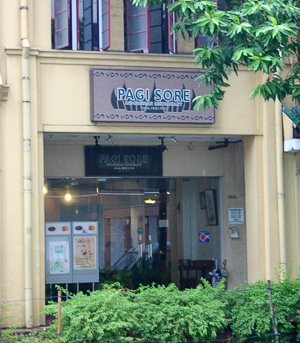
I used to love the food and excellent service at Sanur, especially the branch in Centerpoint in the 90s, but have found them to be on the decline since. Pagi Sore - meaning morning and evening in Indonesian was first established in 1989 in Duxton, and moving to Amoy Street, and finally settling in China Square.

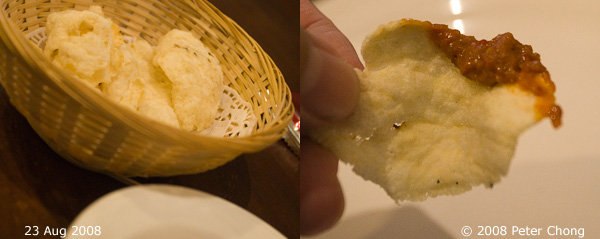
A traditional starter is belinjau crackers. Made from the germ of the belinjau tree, it is deep fried, and served with excellent home-made sambal belachan. The slightly bitter taste of the cracker, compliments the spicy, fragrance of the sambal belachan.

Sambal is a condiment made by pounding various kinds of chilli with toasted belacan. Belacan is made from a paste of fermented prawns, and sundried to form cakes. The cakes are then grilled, and packs a wonderful, intense fragrance, and salty taste of concentrated prawns.

It is bitter normally, so I much preferred it with the sambal.


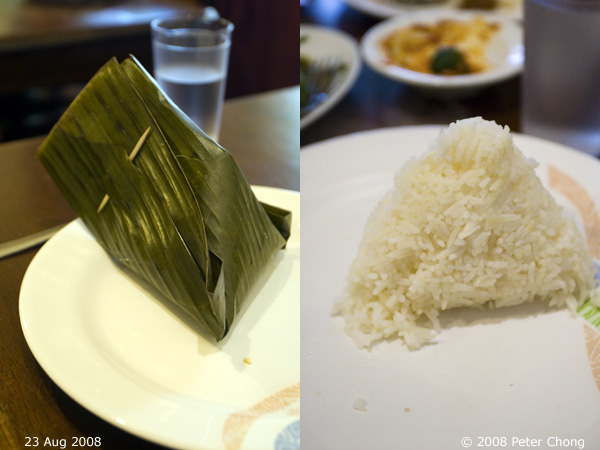
Rice was served in a kinda nice ketupat (dumpling) style...wrapped in a banana leaf, the rice was fragrant, fluffy. I am not sure if the rice is cooked in the banana leaf, but I suspect not, as it remained wonderfully fluffy, so probably it was steamed, and wrapped while still hot in the banana leaf. The heat is sealed within the leaf, which also imparts a gentle fragrance to the rice.


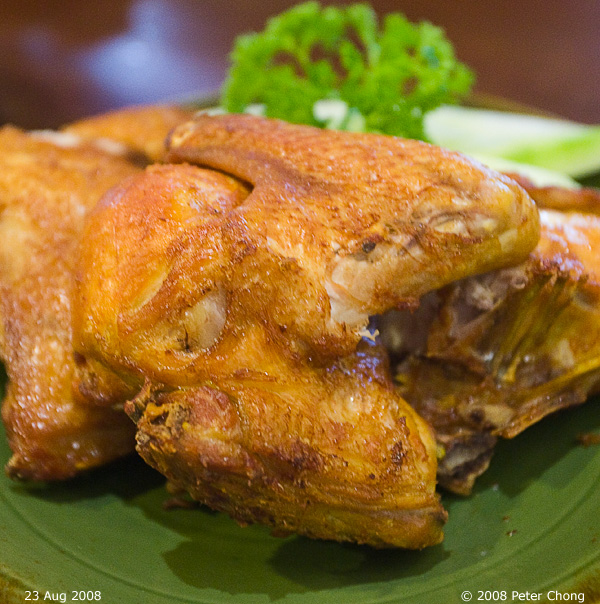
First dish was a fried chicken dish - Ayam Goreng Bumbu. The chicken was fried to golden brown. Bumbu is a typical Indonesia spice...made from a blend of spices would include cinnamon, star anise, coriander seed, cumin seed, cardamom and chili, crushed up and cooked down into a gravy, Somehow, I found this dish to be nothing really special, just regular fried chicken.

The skin was... umm... sweet, I don't really know, but it was different... in a good way.


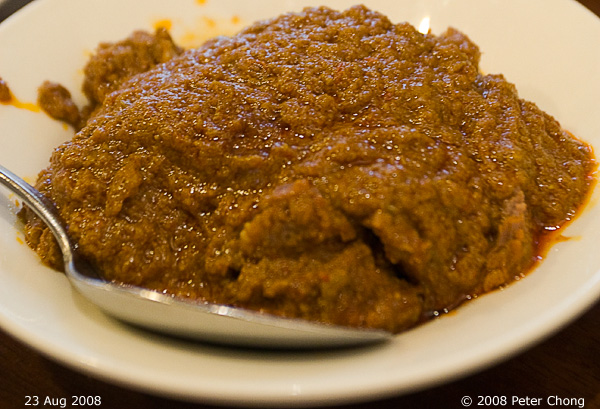
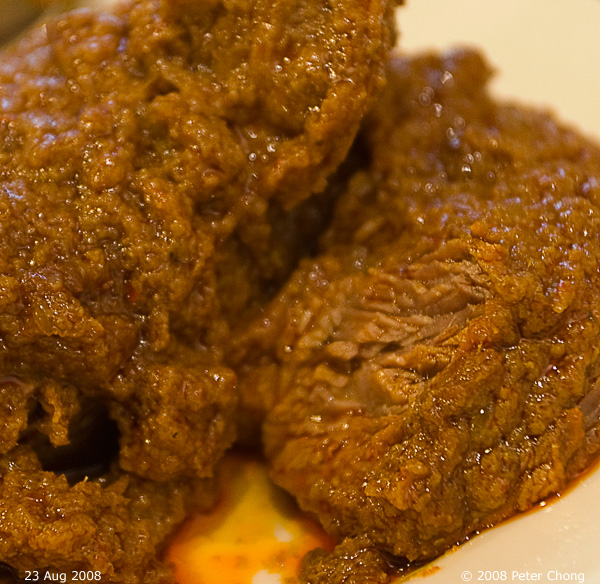
The beef rendang was heavily smothered in gravy...this was a healthier version than the traditional Malay rendang, which uses grated coconut in the gravy. The gravy is thick, smooth, and lacks the crunch of grated coconut, but still remains very tasty.


The meat used was a cut comprising of much connective tissue which can tend to be tough, but becaus rendang cooking method is over a long time in spices and coconut milk, the beef was rendered tender, and flavourful. The collagen in the connective tissue provided some textural interest to the tongue in contrast to the soft fibrous meat.


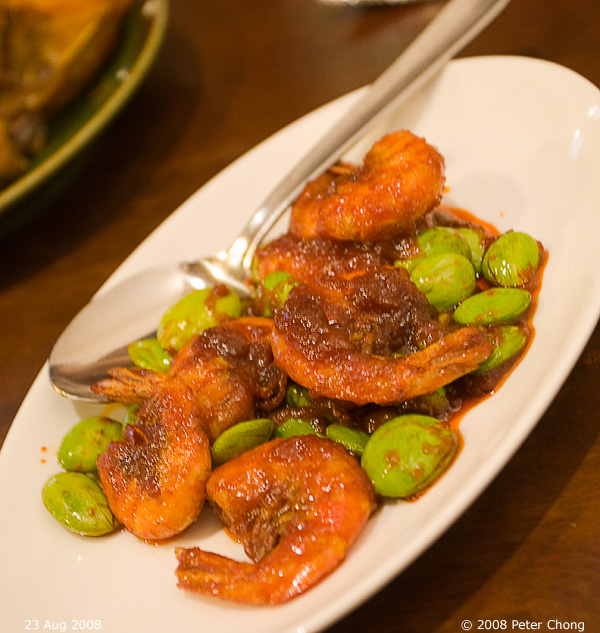
Their version of petai served with prawns proved to be very special. Petai is made from twisted cluster bean. The beans used in this dish were smaller than those found in the wet market. I suspect they are possibly Indonesian sourced...compared to the more typical Malaysian or Thai cultivars which tend to be larger, and less fragrant. The smaller petai were crunchy, and very fragrant. the special sauce of sweetish sambal belachan added zing and completes this class act.


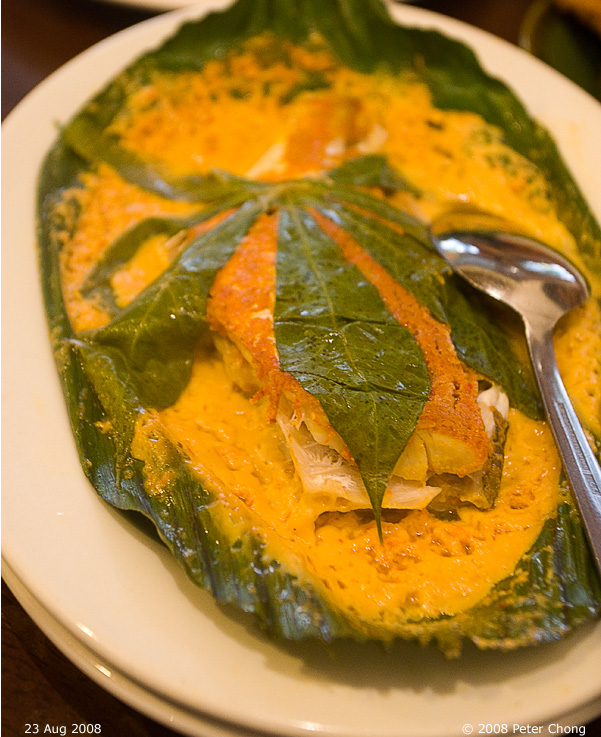
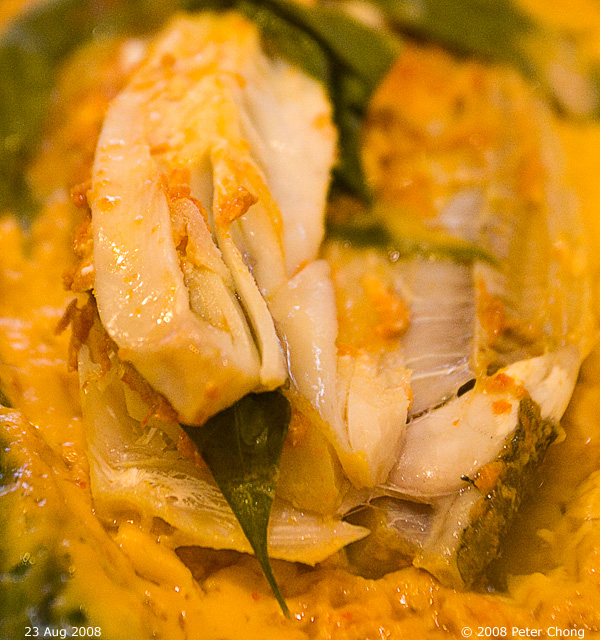
The centerpiece was the fish. Leather jacket fish, de-skinned, and with the head removed was used. Called the Otak Kukus, it was cooked otak style. Typically otak is prepared by either steaming or grilling a mixture of fish paste and spices (typically chillies, garlic, shallots, turmeric, lemon grass and coconut milk) wrapped in a banana leaf. But here, they used a whole fish, and cooked so that the otak paste surrounds the fish.

I didn't like the coagulated coconut milk of this dish, too watery. I prefer the grilled version in which the coagulated coconut milk is firmer, with chunks of ground fish embedded.


Cooked to perfection, the meat was soft, tender, and had great texture and an imbued with the sauce condiments. Excellent taste. This a dish to return to the restaurant for.


Excellent meal in one of the better Indonesian restaurants in town. Surely, for me, a worthy successor to the Sanur crown.

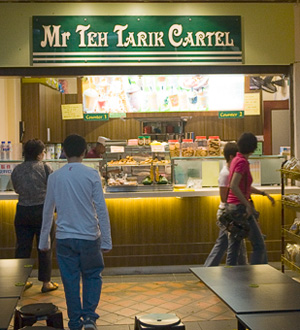
After lunch, we walked over to Mr. Teh Tarik Cartel...a curiously named stall...but is quite a traditional mamak coffeeshop.

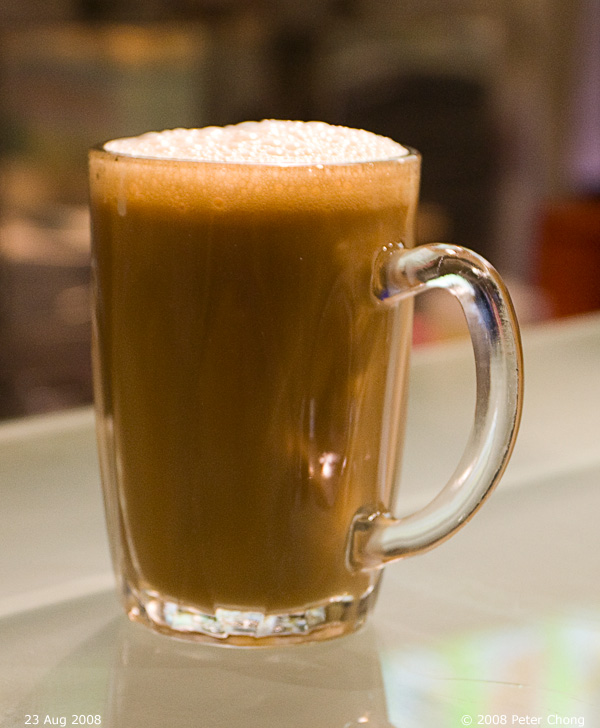
The teh tarik, tea made from a special tea dust and sweetened with condensed milk as only the Indians know how to. This style of tea is commonplace in Singapore, Malaysia and India, and the strong bitter tea conterpoints nicely with the very sweet and creamy condensed milk. The Singapore/Malaysia version features an interesting spectacle of tossing the tea from one container to another...sometimes over a distance of an entire armspan of the master-brewer. A generous froth appears at the head when the mixture is poured into a cup.


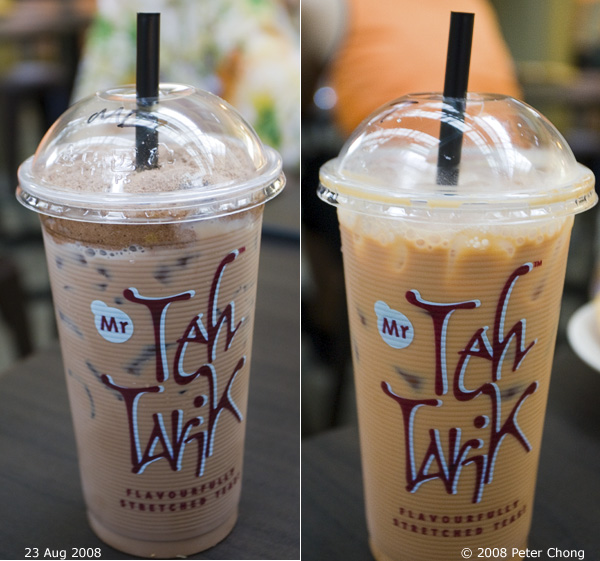
An iced version is also available, the same method of preparation is used, and the mixture then poured into a glass of ice cubes, ass shown below picture right.

Also available, shown left was an milo version...milo was made as a chocholate drink, tarik-ed, and poured into ice, and a generous sprinkling of powdered milo is dusted over.

The Dinosaur didn't have a spoon-straw which made eating the milo powder difficult.


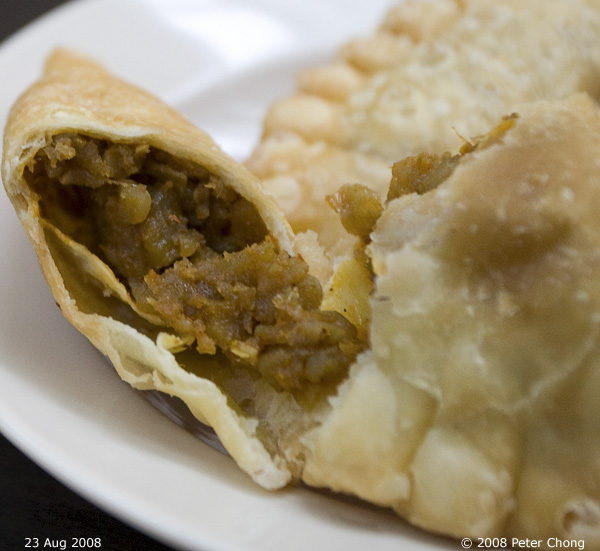
This goes well with a very simple kampung style potato curry puff. Potato curry is stuffed into a pastry wrapping and deep fried. This version is typically served room temperature, in contrast to the Chinese version typified by Old Chang Kee which is always served hot.

As can be seen, the pastry is lightly fried...only managing to be a light yellow golden in color.


Pagi Sore, Indonesian Restaurant and Mr Teh Tarik Cartel, both in China Square.